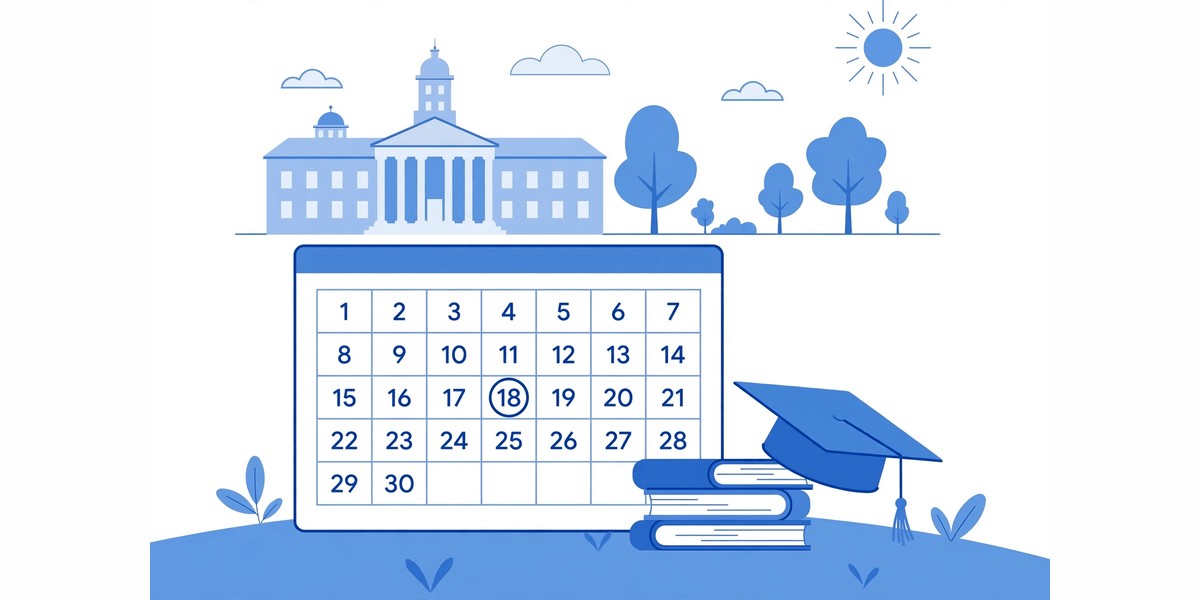
A college semester usually lasts 15 to 16 weeks. That total covers about 15 weeks of classes plus a final exam week, and it does not always include breaks such as Thanksgiving or spring break. A full academic year with fall and spring semesters therefore runs about 30 to 32 weeks of scheduled term time.
Semester length sets the pace of coursework, the timing of tuition bills, and the window for housing, jobs, and internships. This guide explains what counts as a semester week, how fall, spring, and summer terms compare, and how the semester system differs from quarters and trimesters.
What Counts as a Semester Week?
Colleges usually describe a semester as 15 weeks of instruction plus 1 week of final exams, for a total of 16 weeks. Some colleges count the exam week inside the 15 weeks, so they advertise a 15-week semester. The label depends on what the college counts.
Here are the parts that make up a typical semester calendar:
- Instruction weeks: about 15 weeks of classes, lectures, labs, and assignments. This is the core teaching time.
- Final exam week: 1 week at the end of the term for final exams, projects, and presentations.
- Breaks inside the term: fall break, Thanksgiving break, or spring break. A one-week spring break sits inside the semester span, so the calendar stretches longer even though class weeks stay the same.
- Holidays: single days such as Labor Day or Martin Luther King Jr. Day. Classes pause for the day, but the week still counts as an instruction week.
The key point is the difference between calendar span and instruction weeks. A semester that runs from Monday, August 24 to Friday, December 11 covers about 15.7 weeks on the calendar, but that span includes breaks and holidays. When a college says “15-week semester,” it usually means 15 weeks of instruction.
How Long Is a Fall Semester?
A fall semester usually starts in late August and ends in mid-December. Most colleges fit about 15 weeks of classes plus finals into that window.
A typical fall calendar looks like this:
- Classes begin: late August, often the last Monday of the month. In 2026, many colleges started on Monday, August 24.
- Labor Day: the first Monday in September. Classes pause for the federal holiday.
- Fall break: a short break in October, often 2 days attached to a weekend.
- Thanksgiving break: usually Wednesday through Sunday of Thanksgiving week. In 2026, Thanksgiving is Thursday, November 26.
- Last day of classes: early December, followed by one week of final exams.
From August 24 to December 11 is 110 days on the calendar, or about 15.7 weeks. After removing the Thanksgiving break, the instruction time is close to 15 weeks, plus finals.
How Long Is a Spring Semester?
A spring semester usually starts in mid-January and ends in early May. It follows the same structure as fall: about 15 weeks of classes plus a final exam week.
A typical spring calendar looks like this:
- Classes begin: mid-January, often the second Monday of the month. In 2026, many colleges started on Monday, January 12.
- Martin Luther King Jr. Day: the third Monday in January. Classes pause for the federal holiday.
- Spring break: one full week in March, often timed around the middle of the term.
- Last day of classes: late April or early May, followed by one week of final exams.
From January 12 to May 8 is 117 days on the calendar, or about 16.7 weeks. That span includes spring break, so the instruction time is again close to 15 weeks plus finals.
How Long Are Summer Terms?
Summer terms are shorter and more compressed than fall or spring semesters. Colleges split the summer into sessions so students can complete a full course in fewer weeks by meeting more hours per week.
| Summer option | Typical length | How it works |
|---|---|---|
| Full summer semester | 10 to 12 weeks | Similar pace to fall or spring, spread over the summer |
| Summer Session I | 5 to 6 weeks | One course in half the time, with longer daily meetings |
| Summer Session II | 5 to 6 weeks | A second block of courses after Session I ends |
| Mini session or May term | 2 to 4 weeks | A single intensive course, often online |
Semester vs Quarter vs Trimester: How Do They Compare?
Not every college uses semesters. Some use quarters, and a few use trimesters. The systems differ in term length, number of terms per year, and course pace.
| System | Terms per year | Weeks per term | Total term weeks |
|---|---|---|---|
| Semester | 2 (fall, spring) | 15 to 16 | About 30 to 32 |
| Quarter | 3 to 4 | 10 to 12 | About 30 to 33 |
| Trimester | 3 | 12 to 14 | About 36 to 42 |
The semester system is the most common in the United States. Students take 4 to 6 courses per term and go deeper into each subject. The quarter system moves faster, with 3 to 4 courses per quarter. Total instruction time is similar across systems, about 30 weeks per academic year.
Students transferring between systems should check how credits convert: one semester credit usually equals 1.5 quarter credits. For context, a standard year holds 52 full weeks in a year plus 1 extra day.
How to Plan Around Your Semester Calendar
Once you know the semester is about 15 to 16 weeks, you can plan the term in blocks instead of counting days one by one.
1. Mark the fixed dates first
Start with the first day of classes, the last day of classes, finals week, and any breaks. Those dates come from the official academic calendar. Add federal holidays that close the campus, such as Labor Day in fall and Martin Luther King Jr. Day in spring.
2. Divide the term into thirds
A 15-week semester splits neatly into three 5-week blocks: introductions and early assignments, midterms, and major projects plus exam review.
3. Budget study hours by week
A common rule is 2 to 3 hours of study per week for each credit hour. A 3-credit course therefore means 6 to 9 hours of weekly study outside class. Across 15 weeks, that is 90 to 135 study hours per course.
If you have questions about this site or its guides, visit our contact us page.
Frequently Asked Questions
How many weeks is a college semester?
A college semester is usually 15 to 16 weeks. That includes about 15 weeks of classes plus a final exam week.
How many weeks are in a college year?
A college year with fall and spring semesters runs about 30 to 32 weeks of scheduled term time. Summer terms are separate and optional.
How many days are in a college semester?
A 15-week semester covers 105 days of instruction time, and a 16-week semester covers 112 days. The calendar span is longer when breaks are included. For the basic conversion, see our guide to how many days are in 52 weeks.
Does a semester include breaks?
Semester calendars include breaks such as Thanksgiving or spring break, but those break weeks are not instruction weeks. The 15-week count refers to teaching weeks, not the full calendar span.
How long is a summer semester in college?
A full summer semester runs about 10 to 12 weeks. Shorter summer sessions run 5 to 6 weeks each and cover the same material at a faster pace.
Is a semester 4 months or 6 months?
A semester is about 4 months long. Two semesters cover about 8 months of the year, with the remaining months left for summer break or summer terms.
Leave a Reply