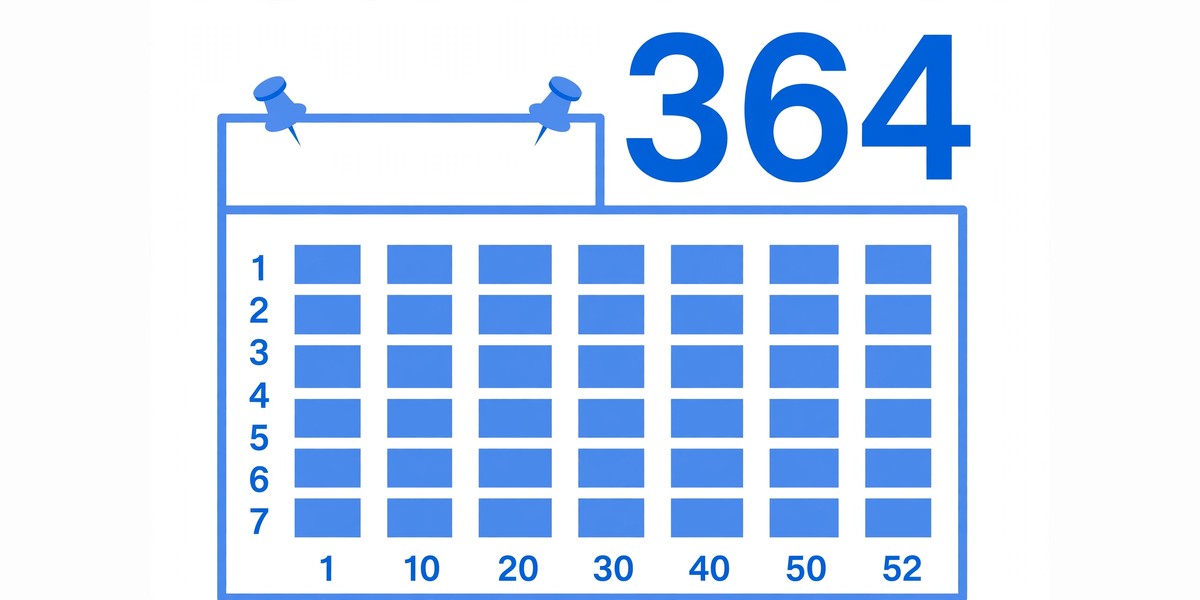
There are 364 days in 52 weeks. Multiply 52 weeks by 7 days per week to get 364. That total is one day short of a standard 365-day year and two days short of a 366-day leap year, which is why every year holds 52 full weeks plus 1 or 2 extra days.
The number 52 shows up everywhere in calendars, pay schedules, and planners. It is the count of full weeks that fit inside a year. This guide walks through the calculation, the missing day or two, and the practical ways the 52-week count is used.
How Do You Calculate Days in 52 Weeks?
The calculation is simple multiplication. Every week has exactly 7 days, so you multiply the number of weeks by 7.
- 1 week = 1 x 7 = 7 days
- 10 weeks = 10 x 7 = 70 days
- 26 weeks = 26 x 7 = 182 days
- 52 weeks = 52 x 7 = 364 days
You can check the result in the other direction too. Divide 364 days by 7 days per week and you get exactly 52 weeks, with no remainder. That clean result is one reason 52 weeks is such a useful planning unit. It divides neatly into halves and quarters: 26 weeks is half of 52, and 13 weeks is one quarter.
| Weeks | Calculation | Days |
|---|---|---|
| 1 week | 1 x 7 | 7 days |
| 4 weeks | 4 x 7 | 28 days |
| 13 weeks (one quarter) | 13 x 7 | 91 days |
| 26 weeks (half a year) | 26 x 7 | 182 days |
| 52 weeks | 52 x 7 | 364 days |
| 53 weeks | 53 x 7 | 371 days |
Why Is a Year Longer Than 52 Weeks?
A standard calendar year has 365 days, and a leap year has 366 days. Because 52 weeks cover only 364 days, every year has leftover days that do not fit into a complete week.
- Standard year: 365 days = 52 weeks + 1 extra day
- Leap year: 366 days = 52 weeks + 2 extra days
That leftover day is the reason the same date falls on a different weekday each year. In a standard year, the calendar shifts forward by one weekday. If January 1 is a Thursday, then January 1 of the next year will be a Friday, because the extra day pushes everything forward by one. After a leap year, the shift is two weekdays, because the extra February 29 adds a second leftover day.
You can see this pattern in 2026. January 1, 2026 is a Thursday, and December 31, 2026 is also a Thursday. The year holds 52 full weeks plus 1 extra day, so it starts and ends on the same weekday. January 1, 2027 is a Friday, exactly one weekday later.
The leap year rule keeps the calendar lined up with the seasons, because Earth takes about 365.25 days to orbit the sun. For more background, see our guide to weeks in a year.
What Does the Extra Day Mean for the Calendar?
The extra day or two may sound small, but it shapes calendars in three visible ways.
1. Weekday drift
Because each standard year has one leftover day, dates move forward by one weekday each year, or by two weekdays after a leap year.
2. Weekend counts
Most years have 52 Saturdays and 52 Sundays, which is 104 weekend days. But the leftover day can add one more weekend day. If a year starts on a Saturday or Sunday, or if a leap year starts on a Friday or Saturday, the year can hold 53 Saturdays or 53 Sundays, for 105 weekend days in total.
3. Week numbering
Week numbering systems must decide what to do with the leftover days. The ISO 8601 system, used widely in business and in Europe, assigns each week a number from 1 to 52 or 53. In an ISO 53-week year, the leftover days combine with days from the next year to form a 53rd week. The United States commonly numbers weeks more simply, starting week 1 on January 1, but the same leftover-day problem applies: the final week of the year is short.
How Many Days Are in Other Week Counts?
People often convert between weeks and days for goals that do not line up with months. The formula never changes: multiply weeks by 7.
| Common period | Weeks | Days |
|---|---|---|
| One month (approximate) | About 4.33 | 28 to 31 |
| 90 days | 12 weeks + 6 days | 90 |
| 100 days | 14 weeks + 2 days | 100 |
| One school semester | 15 to 16 | 105 to 112 |
| Half a year | 26 weeks + 1 day | 182 or 183 |
| One year | 52 weeks + 1 or 2 days | 365 or 366 |
Notice that months do not convert to whole weeks. Months run 28 to 31 days, so a month is about 4.33 weeks on average. If you are comparing schedules, convert everything to days first, then divide by 7.
Where Does the 52-Week Count Matter in Real Life?
Pay schedules
Workers paid every week receive 52 paychecks in a standard year. Workers paid every two weeks receive 26 paychecks, and workers paid twice a month receive 24. The weekly and biweekly schedules follow the 52-week cycle, so in some years biweekly workers receive 27 paychecks instead of 26, because the leftover days push an extra pay date into the year.
School and college calendars
A typical college semester runs 15 to 16 weeks, which is 105 to 112 days of term time. Two semesters add up to about 30 to 32 weeks, leaving the rest of the year for summer break, holidays, and other terms. If you want the full breakdown, read our guide to how many weeks are in a college semester.
Business and savings goals
Many businesses plan in 52-week years because weeks are easier to compare than months. A 52-week fiscal year has four quarters of 13 weeks each. Weekly goals work the same way: saving 50 dollars per week for 52 weeks totals 2,600 dollars.
If you have questions about this site or its guides, visit our about us page.
Frequently Asked Questions
How many days are in 52 weeks?
There are 364 days in 52 weeks. Multiply 52 by 7 to get 364.
Why is 52 weeks not exactly one year?
A standard year has 365 days, which is one day more than 52 weeks. A leap year has 366 days, which is two days more. Those leftover days are why dates shift weekdays each year.
How many days are in 52 weeks and 1 day?
There are 365 days in 52 weeks and 1 day. That is exactly the length of a standard calendar year.
How many days are in a leap year in weeks?
A leap year has 366 days, which equals 52 weeks plus 2 extra days. The extra day is February 29.
How many weeks are in 365 days?
There are 52 full weeks in 365 days, plus 1 leftover day. Divide 365 by 7 to get 52 weeks with a remainder of 1 day.
Do all years have exactly 52 weeks?
Every year holds 52 full weeks, plus 1 or 2 extra days. Some week-numbering systems label certain years as having 53 weeks, but no calendar year holds 53 full weeks of 7 days each.
Leave a Reply