
Direct answer: ISO week numbering is the international standard for labeling the weeks of a year, defined by ISO 8601. Weeks always start on Monday, week 1 is the week containing the first Thursday of January, and each week gets a label like 2026-W01. Most ISO years have 52 numbered weeks, and some have 53. The system gives every week a unique, unambiguous identifier used in business, manufacturing, and finance worldwide.
If you have ever seen a date written as 2026-W01-1 or heard someone say “week 32,” you have met ISO week numbering. It is one of the most practical date standards in the world, yet most people in the United States have never heard of it, because American calendars usually start weeks on Sunday and number them differently.
What Are the Rules of ISO Week Numbering?
The ISO 8601 week date system runs on three simple rules. Once you know them, you can work out the ISO week of any date:
Rule 1: Every week starts on Monday
In the ISO system, Monday is always the first day of the week and Sunday is always the last. This is different from the common US convention, where printed calendars and planners start the week on Sunday. The Monday start keeps weekends together at the end of each week, which makes business planning cleaner.
Rule 2: Week 1 contains the first Thursday of January
ISO week 1 of any year is defined as the week that contains the first Thursday of January. An equivalent definition that is easier to apply: week 1 is the week containing January 4. This rule guarantees that week 1 always contains at least four days of the new year, which keeps the numbering stable.
A useful consequence: the first few days of January can belong to the last week of the previous ISO year. For example, ISO week 1 of 2026 ran from Monday, December 29, 2025, to Sunday, January 4, 2026. The year 2026 begins in the calendar, but the first days of that week still carry 2025 calendar dates.
Rule 3: An ISO year has 52 weeks, or 53 in special cases
An ISO year has 53 weeks when January 1 falls on a Thursday, or when it is a leap year that begins on a Wednesday. In every other case, the ISO year has 52 weeks. This rule is exact, not approximate, and it can be checked against any calendar.
Verified examples make the rule concrete:
| ISO year | January 1 weekday | Leap year? | ISO weeks |
|---|---|---|---|
| 2025 | Wednesday | No | 52 |
| 2026 | Thursday | No | 53 |
| 2027 | Friday | No | 52 |
| 2028 | Saturday | Yes | 52 |
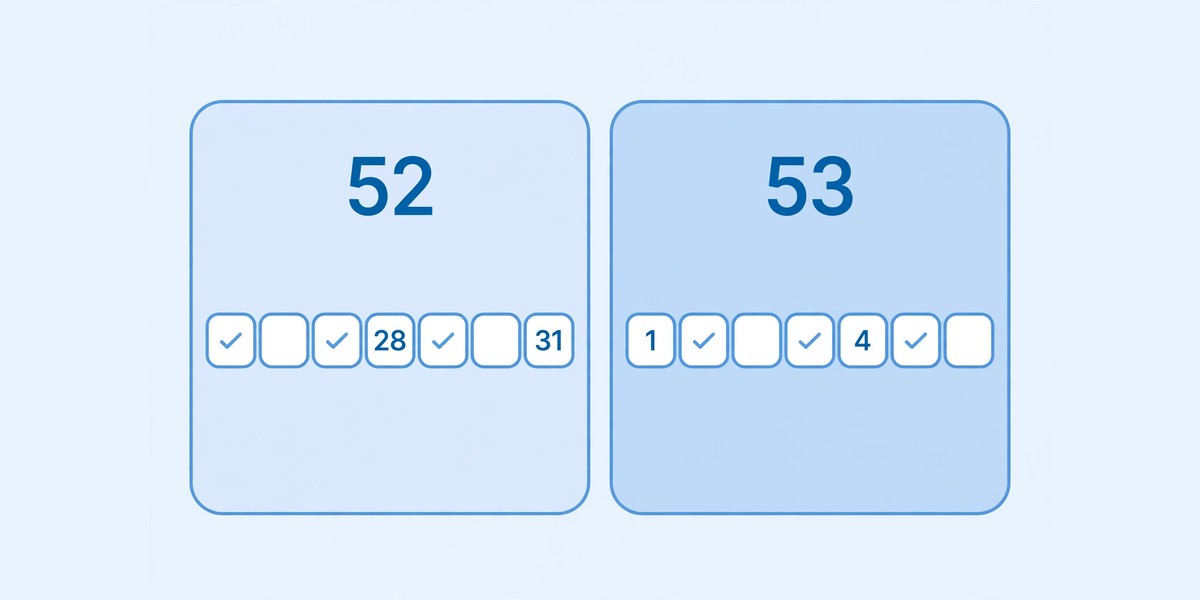
Notice that 2026 has 53 ISO weeks because January 1, 2026, is a Thursday. The year 2028 is a leap year, but because January 1, 2028, is a Saturday, it still has only 52 ISO weeks. The leap year alone does not trigger a 53-week year; the starting weekday decides.
What Does ISO Week Notation Look Like?
ISO week dates are written in the format YYYY-Www-d, where YYYY is the ISO year, ww is the week number from 01 to 53, and d is the weekday number from 1 (Monday) to 7 (Sunday). The “W” separates the year from the week number so the date cannot be confused with a month.
- 2026-W01-1 means Monday of ISO week 1 of 2026, which is December 29, 2025.
- 2026-W01-7 means Sunday of ISO week 1 of 2026, which is January 4, 2026.
- 2026-W53-4 means Thursday of ISO week 53 of 2026, which is December 31, 2026.
- 2027-W01-1 means Monday of ISO week 1 of 2027, which is January 4, 2027.
Weekday numbers are also useful on their own: day 1 is Monday through day 7 is Sunday. You can drop the day number and write just 2026-W32 to mean ISO week 32 of 2026, which is common in planning documents and production schedules.
How Does ISO Numbering Differ from US Week Conventions?
The United States has no single official week-numbering standard, which is why the ISO system feels unfamiliar. Three approaches are common in the US, and each differs from ISO:
- Sunday-start weeks: Most American wall calendars, planners, and scheduling apps begin the week on Sunday. A week that ISO calls one Monday-to-Sunday block gets split across two Sunday-start rows.
- Simple January 1 counting: Some systems call the week containing January 1 “week 1” no matter which weekday it starts on. That produces partial first weeks of one to six days, while ISO week 1 is always a full seven-day week.
- School and fiscal calendars: US schools often number weeks of the instructional term starting from the first day of classes, so “week 5” means the fifth week of school. For context on how school weeks are counted, see our guide to how many weeks are in a school year.
These US conventions work fine locally, but they create ambiguity across borders. A “week 1” in a Sunday-start American planner may cover different days than “week 1” in a European system. The ISO standard removes that ambiguity, which is why international business adopted it.
Who Uses ISO Week Numbers?
ISO week numbering is the working language of scheduling in many industries:
- Manufacturing and logistics: Production runs, shipping schedules, and delivery windows are planned by week number, so a factory in Ohio and a supplier in Germany mean the same days when they agree on week 32.
- Finance and payroll: Companies with weekly or biweekly pay cycles use ISO weeks to define pay periods consistently, especially across countries. A 53-week ISO year can create an extra pay period that payroll teams must plan for.
- Retail and inventory: Retailers compare “week 48 this year versus week 48 last year” to measure seasonal sales, because ISO weeks line up the same weekdays year after year.
- European business calendars: Week numbers are printed on everyday calendars and diaries across much of Europe, where saying “let us meet in week 41” is as normal as naming a date.
- Software and data systems: Databases, spreadsheets, and programming languages include ISO week functions because the standard is unambiguous and easy to compute.
The 53-week years deserve special attention in payroll and accounting. When an ISO year has 53 weeks, employees paid weekly receive 53 paychecks instead of 52, and budgets built on 52 weeks need adjustment. Knowing which years have 53 weeks, such as 2026, lets finance teams plan ahead.
How Do You Find the Current ISO Week?
Finding the current ISO week takes seconds with any of these methods:
- Search online: Typing “current ISO week number” into a search engine returns the answer immediately, usually with the full YYYY-Www format.
- Use a spreadsheet: In Excel or Google Sheets, the formula =ISOWEEKNUM(TODAY()) returns the current ISO week number, and =YEAR(TODAY()) combined with it gives the ISO year.
- Check a week-number calendar: Many digital calendars can display ISO week numbers alongside dates; look for a “week numbers” option in the calendar settings.
- Count from a known week: If you know that ISO week 1 of 2026 began on Monday, December 29, 2025, you can count forward in seven-day steps to reach any week of the year.
Programmers can also get the ISO week from most date libraries. In Python, for example, calling isocalendar() on a date object returns the ISO year, week number, and weekday in one step.
How Does ISO Numbering Fit the Standard Year?
ISO week numbering does not change how long a year is; it only changes how the weeks are labeled. This numbering sits inside the same calendar that gives every year a little more than 52 weeks in a year: a standard year is 52 weeks plus one day, and a leap year is 52 weeks plus two days. The ISO system simply assigns those days to numbered Monday-start weeks, occasionally producing a 53-week ISO year.
That consistency is part of the standard’s appeal. Whether you count weeks the American Sunday-start way, the ISO Monday-start way, or by school terms, the underlying year is the same length. ISO 8601 just provides the one labeling system that the whole world can share.
If you have questions about our guides or spot a date we should double-check, contact us and we will look into it.
Frequently Asked Questions
What is ISO week numbering in simple terms?
It is the international standard for numbering the weeks of a year. Weeks start on Monday, week 1 contains the first Thursday of January, and dates look like 2026-W01-1.
Which years have 53 ISO weeks?
An ISO year has 53 weeks when January 1 is a Thursday, or when it is a leap year starting on a Wednesday. The year 2026 is an example: January 1, 2026, is a Thursday, so ISO 2026 has 53 weeks.
Can January 1 belong to the previous ISO year?
Yes. When January 1 falls on a Friday, Saturday, or Sunday, it belongs to the final ISO week of the previous year. January 1, 2027, is a Friday, so it is part of ISO week 53 of 2026.
What does 2026-W01-1 mean?
It means Monday of ISO week 1 of the ISO year 2026, which is December 29, 2025. The W01 is the week number and the final 1 is the weekday number for Monday.
Why do ISO weeks start on Monday instead of Sunday?
The Monday start keeps the five working days together at the beginning of the week and the weekend together at the end, which matches how businesses plan. It also matches the convention used across most of Europe and international standards.
Is ISO week numbering the same as the week numbers on my US calendar?
Usually not. Most US calendars start weeks on Sunday and number them differently, so their week numbers can differ from ISO week numbers by one. Business and logistics systems use the ISO version for consistency.
Leave a Reply