
In the United States, maternity leave is most commonly 12 weeks, the unpaid, job-protected leave guaranteed by the federal Family and Medical Leave Act (FMLA) for eligible employees. Actual leave varies: some employers offer paid leave, and several states add paid family leave, so total time off can range from a few weeks to six months or more.
How many weeks is maternity leave in the US?
There is no single national number, because US maternity leave is made up of several overlapping pieces rather than one program. The best-known piece is FMLA, which gives eligible employees up to 12 workweeks of leave in a 12-month period. Many new mothers also use short-term disability insurance, employer-paid leave, state paid family leave, or saved vacation time. The table below shows the main pieces and their typical lengths.
| Type of leave | Typical length | Paid or unpaid |
|---|---|---|
| FMLA (federal) | 12 weeks | Unpaid, job-protected |
| Short-term disability, vaginal birth | 6 weeks | Partial pay through insurance |
| Short-term disability, C-section | 8 weeks | Partial pay through insurance |
| Employer-paid parental leave | Varies, often 0 to 16 weeks | Paid, if offered |
| State paid family leave | Up to 12 weeks in several states | Paid, where available |
The key point is that these pieces usually overlap rather than stack. Short-term disability and FMLA normally run at the same time, so a mother recovering from a vaginal birth might use 6 weeks of disability inside her 12 weeks of FMLA, not 6 plus 12 weeks. That is why the headline number most people quote is 12 weeks, even though the paid portion is often shorter.
What does FMLA cover, and who qualifies?
FMLA is a federal law that gives eligible employees up to 12 workweeks of leave for the birth of a child and for bonding, as well as for adoption or foster placement. During FMLA leave, the employer must hold the employee’s job (or an equivalent one) and continue group health insurance on the same terms as if the employee were still working. The leave itself is unpaid under federal law.
Not every worker qualifies. To be eligible, an employee must have worked for the employer for at least 12 months, logged at least 1,250 hours in the 12 months before the leave starts, and work at a site where the employer has 50 or more employees within 75 miles. Part-time workers with fewer hours and employees of very small businesses may fall outside FMLA, which is one reason actual leave varies so much.
Twelve weeks equals 84 calendar days, or just under three months. Fathers are covered too: eligible fathers can take the same 12 weeks of FMLA leave for birth and bonding, although employer-paid paternity leave is usually shorter where it exists.
Which states offer paid family leave?
A growing number of states run their own paid family leave programs, the main reason some mothers receive pay during leave though federal law does not require it. California’s program pays benefits for up to 8 weeks. New York, New Jersey, Washington, Massachusetts, and Colorado each offer up to 12 weeks, and more states have programs starting in the coming years.
State benefits usually run at the same time as FMLA leave, not in addition to it. A mother in New York might receive up to 12 weeks of paid state benefits during her FMLA, while a mother in a state without a program would have the same job protection but no state pay. Some large employers add 8 to 16 weeks of fully paid leave, and a few offer six months or more.
Because programs differ by state and change often, check your own state’s current rules and your employer’s written policy before planning dates. The numbers here describe the common national picture, not a guarantee for any one workplace.
How do the weeks add up in practice?
Take an example. Suppose a mother starts leave on Monday, March 2, 2026. Twelve weeks is 84 days, so her FMLA period runs through Sunday, May 24, 2026, and she returns on Monday, May 25, 2026. If she had a vaginal birth, short-term disability would typically cover the first 6 of those 12 weeks at partial pay, and the rest would be unpaid unless her employer or state program pays them.
Some parents stretch the total beyond 12 weeks by adding saved vacation days, extra paid weeks, or additional unpaid time agreed with the employer. Others return sooner for financial reasons, because unpaid leave is hard to afford. Both patterns are common, and neither changes the legal baseline: 12 weeks is the federal job-protected floor for eligible employees, not a required length or a ceiling.
How does 12 weeks compare with a year?
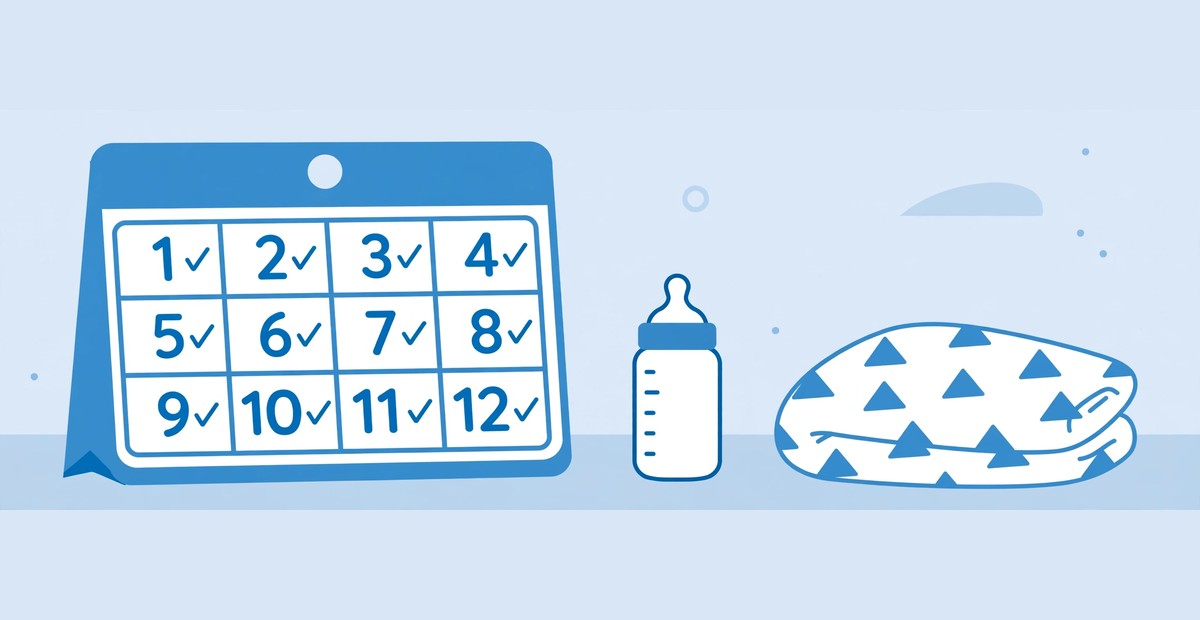
Twelve weeks is about 23 percent of a year, since a standard year has 52 weeks in a year plus 1 day. Maternity leave at the FMLA standard is roughly one quarter of a working year, which is why employers and families plan it as a major event rather than a short absence. Counting it in weeks, rather than months, avoids confusion: 12 weeks is 84 days, while three calendar months can run from 89 to 92 days.
Parents often count weeks for holidays too, such as how many weeks until Halloween. The method is the same every time: find the gap in days, divide by 7, and keep the remainder. Questions about week counting in general can be sent through our contact page.
How to plan your maternity leave week by week
A simple planning sequence keeps the week count straight and avoids surprises:
- Confirm FMLA eligibility with your employer, including the 12-month and 1,250-hour tests.
- Ask human resources what paid leave, disability coverage, and state benefits apply to you, and whether they run with FMLA.
- File any state paid-leave claim early, since some programs need paperwork before the birth.
- Set your start date, add 84 days to find the end of a 12-week leave, and confirm the return date in writing.
- Decide whether to add vacation days or extra unpaid time, and get that agreement in writing too.
Writing the dates down as weeks and as calendar dates prevents the most common planning mistake: treating 12 weeks as exactly three months. A leave starting March 2 ends May 25, not June 2, and that one-week difference matters for childcare bookings and return-to-work plans.
Frequently Asked Questions
Is maternity leave 12 weeks in every state?
FMLA sets a 12-week federal floor for eligible employees everywhere in the US, but states and employers can add more. Total leave ranges from 12 weeks of unpaid protection to longer paid periods in states with their own programs.
Is maternity leave paid in the US?
There is no federal requirement for paid maternity leave. Pay depends on your employer, your state, and any short-term disability insurance you hold.
Does short-term disability add extra weeks on top of FMLA?
Usually not. Short-term disability normally runs at the same time as FMLA leave, so it pays part of the 12 weeks rather than extending them.
Can fathers take 12 weeks of leave too?
Yes, eligible fathers can take up to 12 weeks of FMLA leave for the birth of a child and for bonding, although employer-paid paternity leave is usually shorter than paid maternity leave.
How many weeks is maternity leave after a C-section?
Short-term disability often covers 8 weeks after a C-section instead of 6, but the FMLA job-protected period stays at 12 weeks either way.
How do I count 12 weeks from my start date?
Add 84 days to the start date. For example, leave starting Monday, March 2, 2026, runs 12 weeks and ends with a return on Monday, May 25, 2026.
Leave a Reply