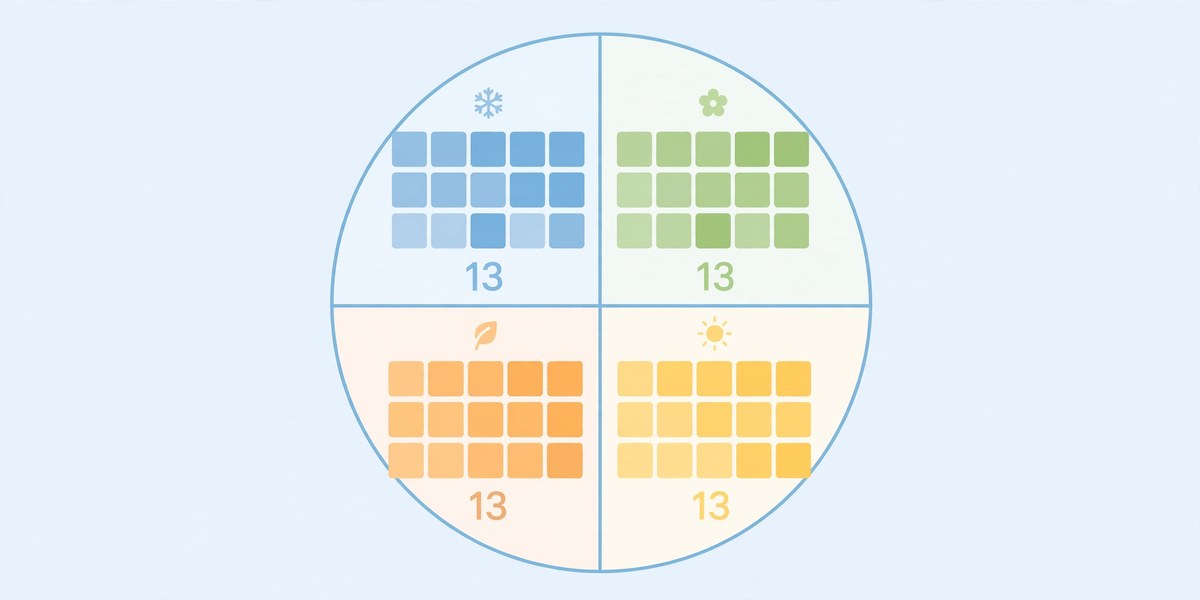
Each season lasts about 13 weeks. A year holds 52 weeks in a year plus 1 or 2 extra days, and those weeks divide almost evenly into four: spring, summer, fall, and winter each get roughly a quarter of the year. The exact count per season is 12.9 to 13.4 weeks, because the seasons do not all have the same number of days.
The precise figure depends on how you define a season. Meteorologists use fixed calendar months, which makes the math clean. Astronomers use the equinoxes and solstices, which makes the numbers shift a little from year to year. This guide covers both, with tables you can quote.
How Many Weeks Are in Each Season? The Short Answer
Using the standard meteorological seasons (fixed calendar months), each season lasts:
| Season (meteorological) | Months | Days | Weeks |
|---|---|---|---|
| Spring | March, April, May | 92 | 13.14 |
| Summer | June, July, August | 92 | 13.14 |
| Fall | September, October, November | 91 | 13.00 |
| Winter | December, January, February | 90 (91 in a leap year) | 12.86 (13.00 in a leap year) |
In round numbers: every season is about 13 weeks long. The four seasons add up to 365 days, which is 52 weeks plus 1 day, exactly matching the standard year.
Why the Seasons Are Not Exactly 13 Weeks
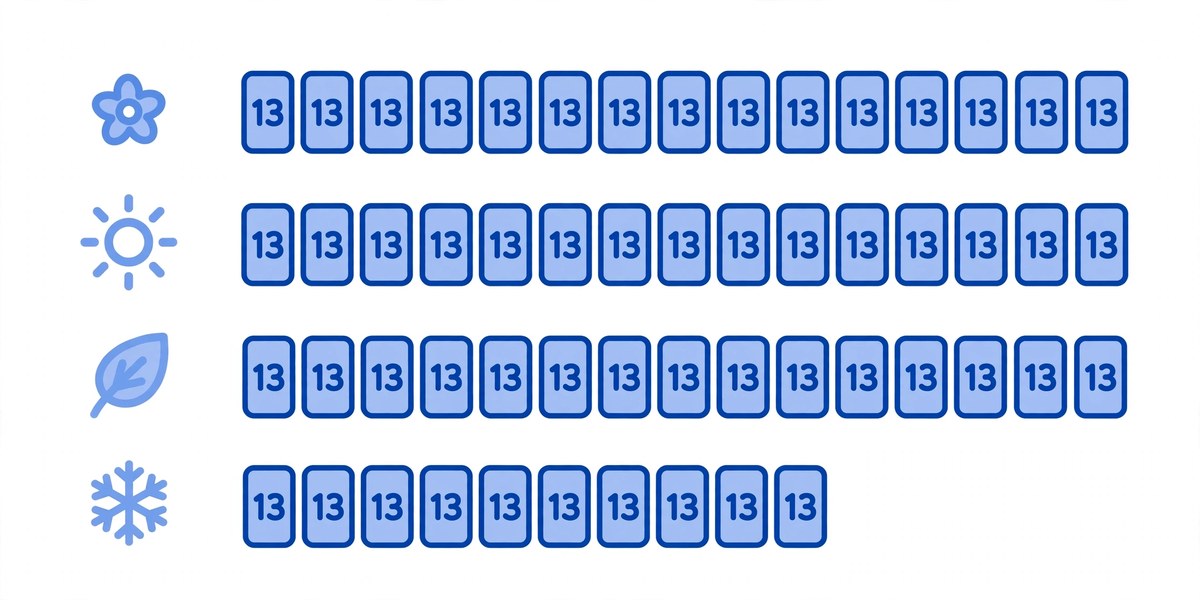
Thirteen weeks is 91 days (13 x 7). If every season were exactly 13 weeks, the year would be exactly 364 days. The real year is 365 or 366 days, so the calendar has to hand out 1 or 2 extra days somewhere. Meteorologists give them to spring, summer, and winter-in-leap-years, which is why those seasons run 92 or 91 days instead of a flat 91.
This is the same reason a year is 52 weeks plus 1 day rather than exactly 52 weeks: the leftover days have to land somewhere, and the seasons absorb them unevenly.
Astronomical Seasons: Weeks Between Equinoxes and Solstices
Astronomical seasons begin on the equinoxes and solstices, so their lengths change slightly each year. For 2026 in the Northern Hemisphere, the day counts work out like this:
| Season (astronomical, 2026) | Starts | Ends | Days | Weeks |
|---|---|---|---|---|
| Spring | March 20 | June 21 | 93 | 13.29 |
| Summer | June 21 | September 23 | 94 | 13.43 |
| Autumn | September 23 | December 22 | 90 | 12.86 |
| Winter | December 22 | March 20, 2027 | 88 | 12.57 |
The astronomical seasons are less even than the meteorological ones: summer is the longest at about 13.4 weeks, and winter is the shortest at about 12.6 weeks. This unevenness comes from Earth’s elliptical orbit, which moves fastest near the winter solstice. The equinox and solstice dates can also shift by a day from year to year, so treat these figures as 2026 values rather than permanent constants.
Which Definition Should You Use?
Most week-counting questions work better with the meteorological definition, for three reasons:
- The month boundaries are fixed, so the day counts never change from year to year (except February in leap years).
- The week counts are stable: 13.14, 13.14, 13.00, and 12.86 (or 13.00 in a leap year).
- US weather reporting, from the National Weather Service to seasonal climate summaries, uses the meteorological seasons.
Use the astronomical definition when the question is about daylight, equinoxes, or the solstices themselves. For planning, scheduling, and budgeting by weeks, the meteorological seasons are the practical choice.
How the Seasons Add Up to a Full Year
Adding the four meteorological seasons gives the familiar yearly total:
- 92 + 92 + 91 + 90 = 365 days in a common year.
- 365 / 7 = 52 weeks plus 1 day.
- In a leap year, February 29 falls in winter: 92 + 92 + 91 + 91 = 366 days.
- 366 / 7 = 52 weeks plus 2 days.
Notice that winter is the only season affected by leap years, because February sits inside it. Winter goes from 12.86 weeks to exactly 13.00 weeks in a leap year, making all four seasons within a fraction of a week of each other.
Real-World Uses for Season Week Counts
Knowing each season is about 13 weeks helps with everyday planning:
- Quarterly goals: a 13-week quarter maps neatly onto one season, which is why many US businesses run 13-week planning cycles.
- School calendars: a typical US fall semester runs about 15 to 16 weeks, slightly longer than the 13-week fall season, while a summer term is much shorter.
- Home projects: a “spring cleaning and renovation” plan with a 13-week window covers the whole meteorological spring (March through May).
- Fitness programs: popular 12-week training programs fit comfortably inside a single 13-week season, leaving a buffer week at each end.
If you enjoy this kind of calendar math, the companion guide How Many Weeks in a Decade? scales the same idea up to ten-year spans.
For more about how this site approaches calendar math, see our about page.
Frequently Asked Questions
How many weeks are in each season?
About 13 weeks each. Spring and summer are 13.14 weeks, fall is 13.00 weeks, and winter is 12.86 weeks, or 13.00 weeks in a leap year.
Which season has the most weeks?
Spring and summer tie for the longest meteorological seasons at 92 days (13.14 weeks). By the astronomical definition, summer is the longest at about 13.4 weeks.
Why is winter shorter than the other seasons?
Winter has only 90 days in a common year because February has 28 days. In a leap year, February 29 brings winter to 91 days, exactly 13 weeks.
Are all seasons the same length?
No. Meteorological seasons run 90 to 92 days, and astronomical seasons run 88 to 94 days depending on the year. Every season is close to 13 weeks but none is exactly that.
How many weeks are in a season of 90 days?
90 days divided by 7 equals 12.86 weeks, which is 12 full weeks plus 6 days.
Do the seasons add up to 52 weeks?
Almost. The four meteorological seasons total 365 days, which is 52 weeks plus 1 day. In a leap year they total 366 days, or 52 weeks plus 2 days.
Leave a Reply