
Direct answer: A century contains 5,217.75 weeks on average. That figure comes from the average Gregorian year of 365.2425 days multiplied by 100 years, giving 36,524.25 days, then divided by 7. A specific century varies slightly: the current century, 2001 to 2100, holds 36,524 days, which is 5,217 weeks plus 5 days, because it contains 24 leap years.
What Is a Century?
A century is a period of 100 years. The current century, the 21st century, runs from January 1, 2001 to December 31, 2100. Many people casually count 2000 to 2099 instead, but by the standard calendar count, a new century begins in a year ending in 001, not 000. Either way, the span is 100 years, and the week count differs by only a day or two depending on which exact years are included.
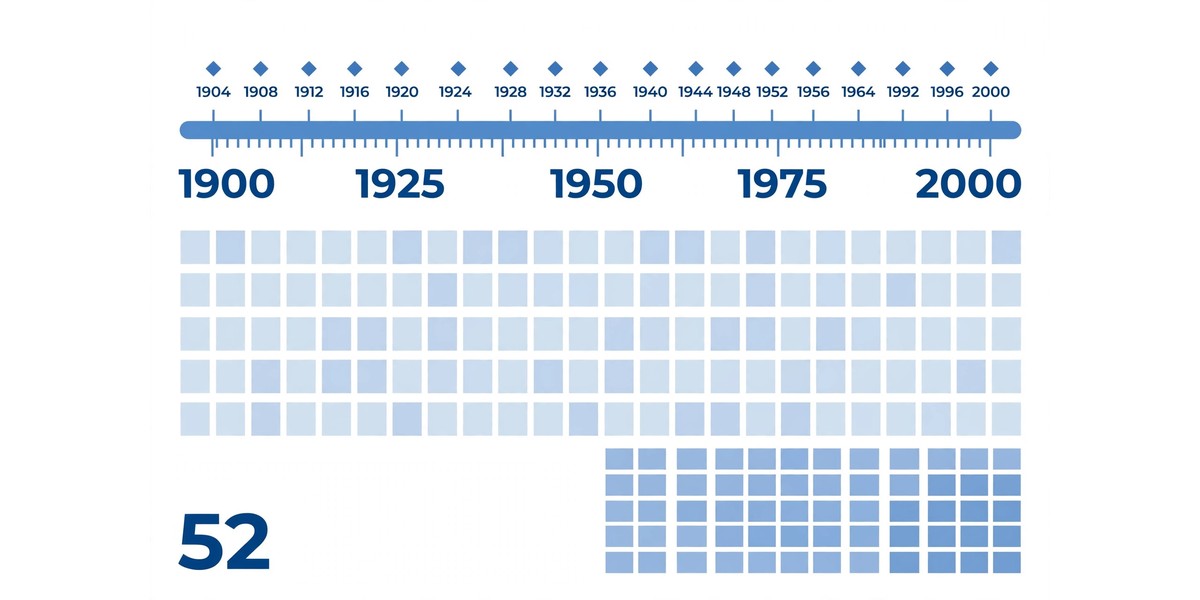
Centuries matter because they expose the slow drift of the calendar. A single year is 52 weeks in a year plus 1 or 2 leftover days, and over 100 years those leftovers add up to more than 17 extra weeks. That is why a century is not simply 52 times 100, or 5,200 weeks.
How Many Weeks Are in 100 Years?
The simple multiplication, 52 weeks times 100 years, gives 5,200 weeks, but it misses the leftover days. Each common year contributes 1 leftover day beyond 52 weeks, and each leap year contributes 2. Over a century, those leftovers total about 124 days, or 17 full weeks plus 5 days, which is exactly the gap between 5,200 and 5,217.
| Century | Leap Years | Total Days | Weeks |
|---|---|---|---|
| 2001 to 2100 (current) | 24 | 36,524 | 5,217 weeks + 5 days |
| 1901 to 2000 | 25 | 36,525 | 5,217 weeks + 6 days |
| Average Gregorian century | 24.25 | 36,524.25 | 5,217.75 weeks |
Why Do Centuries Have Different Leap Year Counts?
The Gregorian calendar adds a leap day every 4 years, but it skips leap day in century years unless the year is divisible by 400. That rule is why the current century has 24 leap years instead of 25: the year 2100 is divisible by 100 but not by 400, so it is not a leap year. The previous century, 1901 to 2000, had 25 leap years, because the year 2000 is divisible by 400 and was a leap year.
This 400-year cycle is the reason the average century has 24.25 leap years. Three out of every four century years lose their leap day, and the fourth keeps it. Over 400 years, the calendar adds 97 leap days, which keeps the average year at 365.2425 days, very close to the true solar year.
- Start with 100 common years: 100 times 365 equals 36,500 days.
- Add one day for each leap year in the century: 24 days for 2001 to 2100.
- The total is 36,524 days. Divide by 7 to get 5,217 weeks with 5 days left over.
- For the average century, use 24.25 leap days instead, giving 36,524.25 days, or 5,217.75 weeks.
How Does a Century Compare to Other Time Spans?
A century is 10 decades, and a decade holds about 521.78 weeks on average, so 10 decades give about 5,217.8 weeks, matching the century figure. A millennium, or 1,000 years, holds about 52,177.5 weeks, which is 10 times the century figure. These relationships are exact for averages, even though any specific century or millennium varies by a day or two.
For everyday planning, the century figure is mostly a curiosity, but it helps with history, genealogy, and long-range records. A family history spanning four generations, about 100 years, covers more than 5,200 weeks of Sundays, birthdays, and holidays. A seasonal countdown, by contrast, is much shorter: see how many weeks until summer for a countdown measured in dozens of weeks, not thousands.
How Long Is a Century in Everyday Terms?
A century is hard to picture, so it helps to break it into smaller units. It contains 1,200 months, 5,217 weeks, and about 36,524 days. A person who lives to 100 has lived through roughly 5,217 Sundays, 100 New Year’s Days, and 25 presidential elections in the United States, held every 4 years. A weekly habit kept for a whole century would be repeated more than 5,200 times, which shows why even small weekly routines add up over a lifetime.
Centennials are also a common way to mark 100 years. Towns, universities, and companies in the United States often celebrate a centennial with a year of events, and the US Postal Service has issued stamps for centennials of states, national parks, and historic events. Each of those celebrations marks 5,217 weeks of history, even if the organizers count the milestone in years rather than weeks.
What About a Century in Other Calendars?
Other calendars give slightly different answers. The Julian calendar, used before the Gregorian reform, adds a leap day every 4 years with no century exception, so a Julian century always has 25 leap years and 36,525 days, or 5,217 weeks plus 6 days. A lunar calendar year of about 354 days would give a century of only about 5,057 weeks, but lunar calendars do not use centuries in the same way, so the Gregorian figure is the standard answer in the United States.
The key point is to name the calendar when the answer matters. For US records, school history, and legal documents, the Gregorian calendar is the default, and 5,217.75 weeks is the average to quote. For a specific century, name its years and count its leap years, as shown in the table above. You can read more about this site’s calendar approach on our contact us page.
Frequently Asked Questions
How many weeks are in a century?
A century holds 5,217.75 weeks on average, and the current century, 2001 to 2100, holds 5,217 weeks plus 5 days.
How many days are in a century?
An average Gregorian century has 36,524.25 days, while the current century has exactly 36,524 days.
Why is a century not exactly 5,200 weeks?
Because each year has 1 or 2 days beyond 52 weeks, and over 100 years those leftover days add about 17 extra weeks.
How many leap years are in the current century?
The current century, 2001 to 2100, has 24 leap years, because 2100 is not a leap year.
How many weeks are in 10 centuries?
Ten centuries make a millennium, which holds about 52,177.5 weeks on average.
Does every century have the same number of weeks?
No. Centuries with a leap century year, like 2000, have one extra day, while others, like the current century, have one fewer.
Leave a Reply