
There are 14 weeks and 2 days in 100 days. Dividing 100 by 7 gives 14 complete weeks with a remainder of 2 days, which is 14.29 weeks as a decimal. The math is simple: 14 times 7 equals 98, and 100 minus 98 leaves 2 days.
A 100-day span comes up more often than you might expect: fitness challenges, new-employee probation periods, school grading windows, and project milestones all use it. This guide shows the conversion, puts 100 days on a real calendar, and gives you a quick table for converting any day count to weeks.
How Do You Convert 100 Days to Weeks?
The method works for any number of days:
- Divide by 7. 100 divided by 7 = 14.2857…
- Take the whole number. That is 14 complete weeks.
- Find the remainder. 14 times 7 = 98. 100 minus 98 = 2 leftover days.
- Optionally, keep the decimal. 100 divided by 7 = 14.29 weeks, rounded to two decimal places.
So you can say “14 weeks and 2 days” when talking to people and “14.29 weeks” when entering the number into a spreadsheet or project plan. Both describe the same span.
What Does 100 Days Look Like on a Real Calendar?
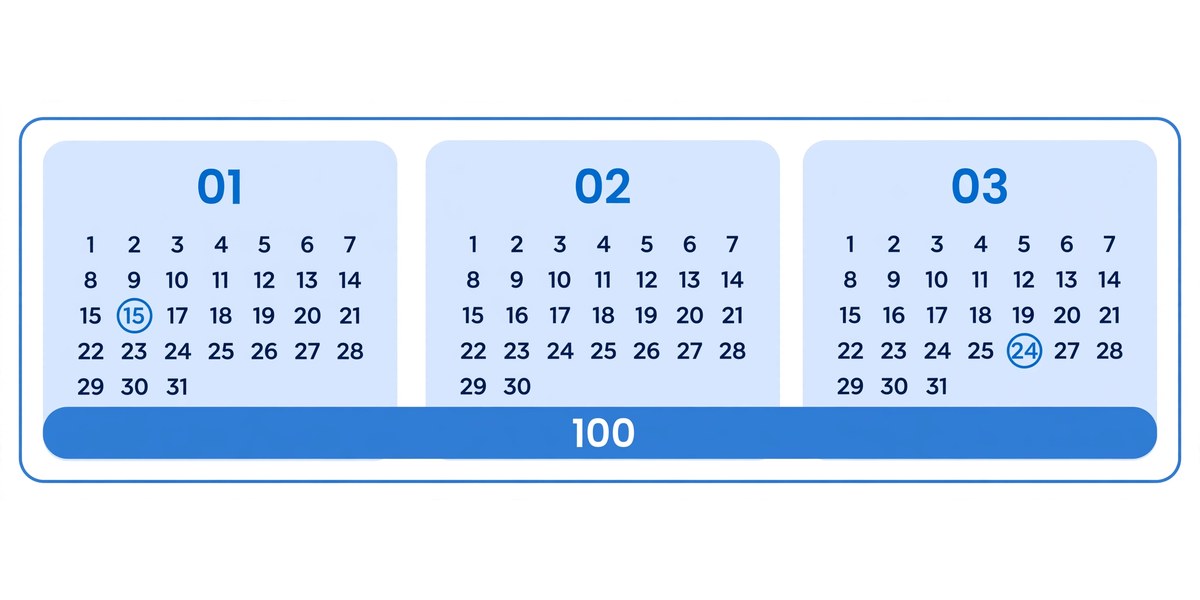
Abstract numbers are hard to picture, so here is 100 days mapped onto real dates.
Starting on Saturday, October 17, 2026, adding 100 days lands on Monday, January 25, 2027. Let us count it in chunks:
- October 17 to October 31: 14 days (2 weeks exactly)
- November: 30 days (4 weeks and 2 days)
- December: 31 days (4 weeks and 3 days)
- January 1 to January 25: 25 days (3 weeks and 4 days)
Add them up: 14 + 30 + 31 + 25 = 100 days. In weeks: 2 + 4 + 4 + 3 = 13 full weeks from the monthly chunks, plus the leftover days (0 + 2 + 3 + 4 = 9 days = 1 week and 2 days), for a total of 14 weeks and 2 days.
Notice that the span crosses a year boundary and a month boundary with different lengths. That is exactly why counting weeks directly is easier than counting months: every week is always 7 days, while months range from 28 to 31 days.
How Many Months Are 100 Days?
People often ask this follow-up, so here is the honest answer: it depends on which months. The average month is about 30.44 days (365 divided by 12), so 100 days is roughly 3.29 average months.
- Using average months: 100 / 30.44 = about 3.3 months
- Using 30-day months: 100 / 30 = 3.33 months, a common business approximation
- On a real calendar: 100 days can cover parts of 3, 4, or even 5 different months depending on the start date
For planning, weeks are more reliable than months because they never change length. A “14-week plan” means the same thing starting in January or July, while a “3-month plan” can vary by several days.
When Would You Need 100 Days in Weeks?
The 100-day span shows up in many US routines and programs:
- New-hire probation: many US employers use a 90 to 100-day probation period, roughly 13 to 14 weeks, before benefits or full status begin.
- Fitness challenges: 100-day workout or weight-loss challenges equal 14 weeks and 2 days of training, a popular length for visible results.
- School terms: a typical US college semester runs about 15 weeks, so 100 days (14.29 weeks) is close to one full semester of classes.
- Project quarters: a calendar quarter is about 13 weeks, so a 100-day project milestone lands just past the end of one quarter.
- Savings goals: the “100-day savings challenge” popular in personal finance circles spans just over 14 weeks of weekly deposits.
- Government transitions: the tradition of judging a US president’s first 100 days covers about 14 weeks and 2 days in office.
In each case, converting to weeks makes scheduling easier. Weekly check-ins, weekly deposits, and weekly training blocks all divide neatly into 14 weeks, with 2 days left over for a final review or rest.
How Do You Convert Other Day Counts to Weeks?
Once you know the divide-by-7 method, any conversion is quick. This table covers the day counts people search for most:
| Days | Complete weeks | Leftover days | Decimal weeks |
|---|---|---|---|
| 30 | 4 | 2 | 4.29 |
| 60 | 8 | 4 | 8.57 |
| 90 | 12 | 6 | 12.86 |
| 100 | 14 | 2 | 14.29 |
| 120 | 17 | 1 | 17.14 |
| 150 | 21 | 3 | 21.43 |
| 180 | 25 | 5 | 25.71 |
| 200 | 28 | 4 | 28.57 |
| 365 | 52 | 1 | 52.14 |
The last row is worth remembering: a standard year holds 52 weeks and 1 day, which is why the total weeks in a year is not a round 52. A leap year adds one more day, giving 52 weeks and 2 days.
If your span is defined by two calendar dates rather than a day count, our guide on how to calculate weeks between two dates walks through that method step by step.
Frequently Asked Questions
How many weeks are in 100 days?
14 weeks and 2 days. Divide 100 by 7 to get 14 complete weeks with 2 days left over, or 14.29 weeks as a decimal.
Is 100 days the same as 3 months?
Not exactly. 100 days is about 3.3 average months, since the average month is 30.44 days. On a real calendar, 100 days can touch 3 to 5 different months depending on the start date.
How many work weeks are in 100 days?
100 days contains 14 full 7-day weeks, so it holds 14 Monday-to-Friday work weeks plus 2 extra days. After subtracting typical weekends, that is about 70 to 72 weekdays.
What date is 100 days from today?
Add 100 days to the current date, or count 14 weeks and 2 days forward. For example, 100 days after Saturday, October 17, 2026 is Monday, January 25, 2027.
Why is it 14 weeks and 2 days instead of just 14 weeks?
Because 14 weeks is only 98 days. The 2 extra days are the remainder when 100 is divided by 7, and ignoring them would make your count 2 days short.
How do I convert any number of days to weeks quickly?
Divide the days by 7. The whole number is complete weeks and the remainder is leftover days. For example, 45 days is 6 weeks and 3 days, since 6 times 7 is 42 and 45 minus 42 is 3.
Have a different day count to convert? The contact us page is the fastest way to send us your question.
Leave a Reply