
A calendar quarter averages 13.04 weeks, which is 91.25 days. In practice, individual quarters range from 12 weeks and 6 days up to 13 weeks and 2 days, depending on which months they contain and whether the year is a leap year. Each quarter is exactly one-fourth of the year’s 52 weeks plus leftover days.
What Is a Quarter of a Year?
A quarter is one-fourth of a calendar year: three months grouped together. The standard calendar quarters used across the United States are:
- Q1: January, February, March
- Q2: April, May, June
- Q3: July, August, September
- Q4: October, November, December
Businesses, investors, and government agencies use quarters for earnings reports, tax estimates, and planning. Because the quarters are measured in months rather than weeks, none of them is exactly 13 weeks long in a normal year.
How Many Weeks Are in Each Quarter?
Here are the exact day and week counts for the four quarters of 2026, a common year:
| Quarter | Months | Days | Weeks |
|---|---|---|---|
| Q1 | Jan, Feb, Mar | 90 | 12 weeks and 6 days |
| Q2 | Apr, May, Jun | 91 | Exactly 13 weeks |
| Q3 | Jul, Aug, Sep | 92 | 13 weeks and 1 day |
| Q4 | Oct, Nov, Dec | 92 | 13 weeks and 1 day |
Q1 is always the shortest quarter because February has only 28 days in a common year. Q2 hits exactly 13 weeks only in common years: April (30), May (31), and June (30) sum to 91 days. Q3 and Q4 each contain two 31-day months, so they run one day past 13 weeks.
Weeks per Quarter in 2027 and 2028
Day counts repeat in common years, so 2027 looks exactly like 2026. Leap years change only Q1, because February gains a day:
| Quarter | 2026 (common) | 2027 (common) | 2028 (leap) |
|---|---|---|---|
| Q1 | 90 days (12 w, 6 d) | 90 days (12 w, 6 d) | 91 days (13 weeks) |
| Q2 | 91 days (13 weeks) | 91 days (13 weeks) | 91 days (13 weeks) |
| Q3 | 92 days (13 w, 1 d) | 92 days (13 w, 1 d) | 92 days (13 w, 1 d) |
| Q4 | 92 days (13 w, 1 d) | 92 days (13 w, 1 d) | 92 days (13 w, 1 d) |
| Year total | 365 days (52 w, 1 d) | 365 days (52 w, 1 d) | 366 days (52 w, 2 d) |
The four quarters always add up to the full year: 365 days, which is weeks in a year totaling 52 weeks and 1 extra day, or 366 days in a leap year with 2 extra days.
How Many Weeks Is a Quarter on Average?
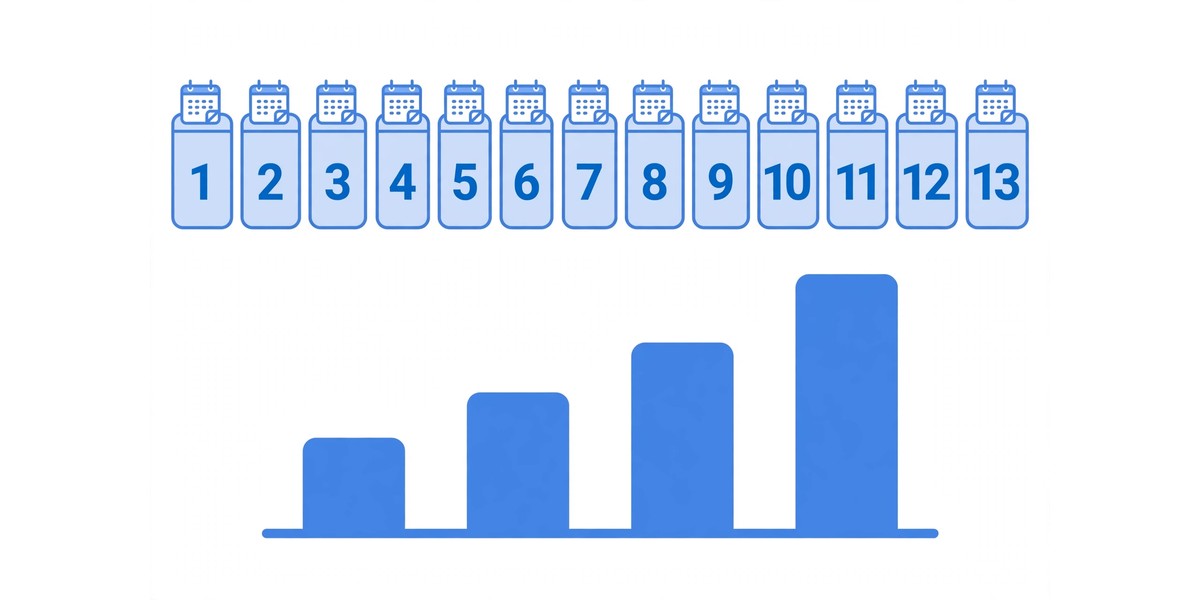
The average calendar quarter is 91.25 days long, which equals 13.0357 weeks. This is the figure to use when you need one number for all four quarters, such as in a budgeting model or a long-range plan.
- Average days per quarter: 365 / 4 = 91.25 days
- Average weeks per quarter: 91.25 / 7 = 13.0357 weeks
- Rounded for everyday use: about 13 weeks
Rounding a quarter to “13 weeks” is off by about a quarter of a day per quarter, or one full day per year. That drift is small enough for casual planning but worth noting in precise financial models.
What About Fiscal Year Quarters?
Not every organization uses the calendar year. The US federal government runs its fiscal year from October 1 to September 30, and many companies choose their own fiscal year start. Fiscal quarters follow the same math: each fiscal quarter is three months long, averaging 13.04 weeks.
The US federal fiscal quarters are:
- Federal Q1: October, November, December
- Federal Q2: January, February, March
- Federal Q3: April, May, June
- Federal Q4: July, August, September
Under this system, the short quarter (with February) is federal Q2 instead of calendar Q1. Companies with retail-heavy businesses sometimes use a 52/53-week fiscal year, where each quarter is exactly 13 weeks and the year ends on the same weekday every year, adding a 53rd week roughly every five or six years.
Why Quarters Matter More Than Months for Planning
Quarters are popular in business because they smooth out the irregular lengths of months while staying aligned with the calendar. A quarter is close enough to 13 weeks that weekly schedules, payroll cycles, and project sprints fit neatly inside it.
Practical examples include:
- Biweekly payroll: employees paid every two weeks receive 6 or 7 paychecks per quarter, since 13 weeks divides into six full pay periods with one week left over.
- Quarterly estimated taxes: the IRS expects estimated tax payments four times a year, each covering roughly 13 weeks of income.
- Project sprints: a 12-week project fits comfortably inside any quarter, leaving a buffer week for review.
- School and sports seasons: a typical 15-week college semester is about one quarter plus two extra weeks, which helps explain why semesters never fit neatly into a single quarter.
For related day-count math, see our guide on how many weekdays are in a year, which breaks down the Monday-through-Friday count behind these weekly figures.
Frequently Asked Questions
How many weeks are in a quarter exactly?
No quarter is exactly the same. Q1 is 12 weeks and 6 days (13 weeks in a leap year), Q2 is exactly 13 weeks, and Q3 and Q4 are 13 weeks and 1 day each.
Is a quarter 12 or 13 weeks?
Most people round a quarter to 13 weeks, which is accurate enough for everyday planning. Only Q1 in a common year is closer to 12 weeks, at 12 weeks and 6 days.
How many days are in a quarter?
A quarter has 90, 91, or 92 days. Q1 has 90 days (91 in a leap year), Q2 has 91 days, and Q3 and Q4 have 92 days each.
How many quarters are in a year?
There are 4 quarters in a year. Together they cover all 52 weeks plus the year’s extra 1 or 2 days.
What are the fiscal year quarters for the US government?
The US federal fiscal year starts October 1, so its quarters are Oct-Dec, Jan-Mar, Apr-Jun, and Jul-Sep. Each follows the same 90 to 92 day pattern as calendar quarters.
How many weeks are in half a year?
Half a year is 26 weeks plus leftover days: about 26.07 weeks (182.5 days on average). The first half of 2026 (Q1 plus Q2) is 181 days, or 25 weeks and 6 days.
Leave a Reply