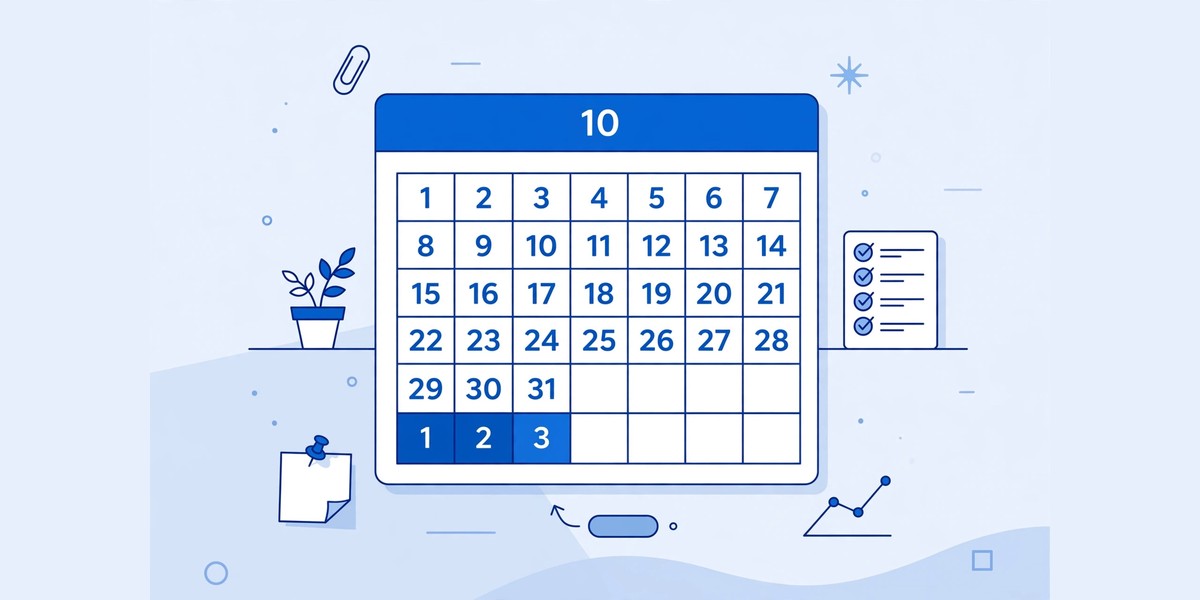
Most years have 8 to 10 months that span five calendar rows, usually 9. On a standard Sunday-start calendar, a month covers five week rows unless February starts on a Sunday in a non-leap year (four rows) or a 31-day month starts on a Friday or Saturday (six rows). A 30-day month starting on a Saturday also spans six rows.
This question comes up in real planning: payroll teams talk about “five-paycheck months,” budget apps warn about “five-week months,” and wall calendars show most months stretching across five rows. This guide explains what a 5-week month means, counts them for real years, and gives the simple rules for 4, 5, and 6-row months.
What does a 5-week month actually mean?
A “5-week month” usually means a month that spans five rows on a wall calendar, not a month with five full seven-day weeks. No month has exactly 35 days; the phrase describes the calendar grid, where each row is one display week.
There is a second meaning used in payroll. A “five-Friday month” or “five-paycheck month” is a month that contains five of a particular weekday. Anyone paid every Friday gets five paychecks in a month with five Fridays, which changes that month’s cash flow. Both meanings come up in planning, so this guide covers both.
All of this builds on one base fact: a standard year is 52 weeks in a year plus 1 extra day, and that structure is what shapes the month grids.
How many 5-week months are in a year?
The short answer is usually 9. Here is the full picture for recent and upcoming years:
| Year | Months spanning 4 rows | Months spanning 5 rows | Months spanning 6 rows |
|---|---|---|---|
| 2026 | 1 (February) | 9 | 2 (May, August) |
| 2027 | 0 | 9 | 3 (January, May, October) |
| 2028 (leap) | 0 | 8 | 4 (January, April, July, December) |
The pattern is steady: every year has 8 to 10 five-row months, usually 9. Only one month can ever span 4 rows, and only in some years, while 6-row months range from 1 to 4 per year.
Here is 2026 month by month, so you can check a wall calendar against it:
| Month | First weekday | Days | Calendar rows |
|---|---|---|---|
| January | Thursday | 31 | 5 |
| February | Sunday | 28 | 4 |
| March | Sunday | 31 | 5 |
| April | Wednesday | 30 | 5 |
| May | Friday | 31 | 6 |
| June | Monday | 30 | 5 |
| July | Wednesday | 31 | 5 |
| August | Saturday | 31 | 6 |
| September | Tuesday | 30 | 5 |
| October | Thursday | 31 | 5 |
| November | Sunday | 30 | 5 |
| December | Tuesday | 31 | 5 |
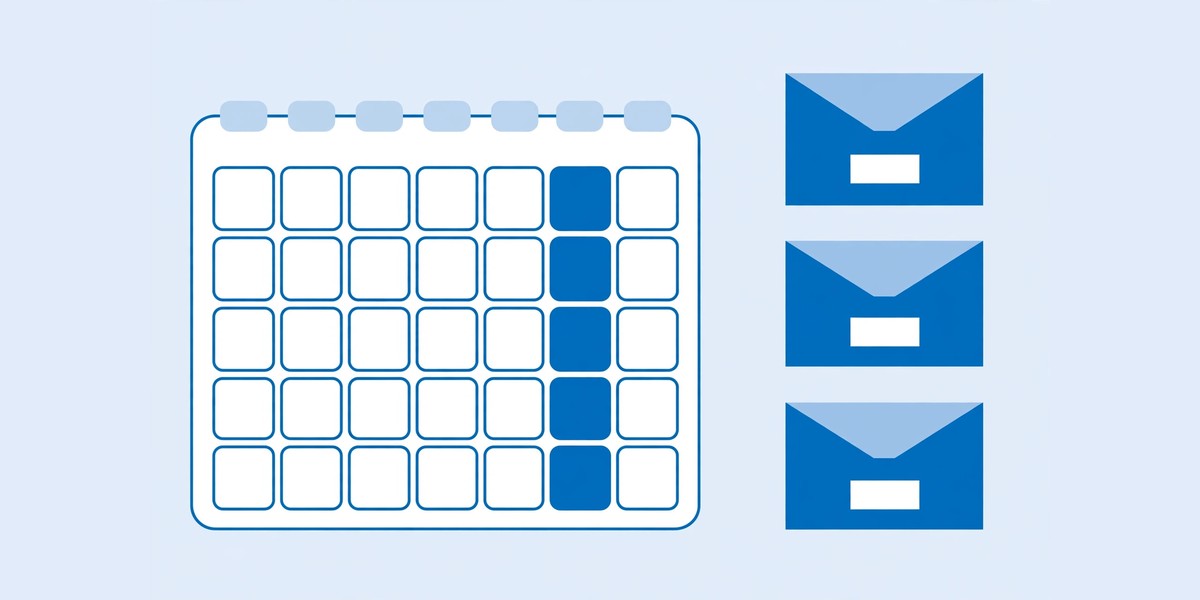
What makes a month span 6 rows?
A month needs 6 rows when its days cannot fit into 5 rows of 7. That happens in exactly two cases on a Sunday-start calendar:
- A 31-day month that starts on a Friday or Saturday. The month opens at the end of a row, so its 31 days spill into a sixth row. In 2026, May starts on a Friday and August starts on a Saturday, so both span 6 rows.
- A 30-day month that starts on a Saturday. The month opens in the last cell of a row and its 30 days spill over as well. This happens less often than the 31-day case.
A handy way to think about it: a month spans 6 rows only when it starts very late in the week and is long enough that the days overflow. February can never span 6 rows, since even 29 days starting on a Sunday fit in 5 rows. Short months that start early in the week compress into fewer rows.
Every year has 1 to 4 six-row months, and leap years tend to have more because February 29 shifts the start days of later months.
What makes a month span only 4 rows?
Exactly one scenario produces a 4-row month: February of a non-leap year that starts on a Sunday. Those 28 days fill four complete weeks with no spillover, giving the only perfect 4-week month the calendar ever shows.
February 2026 is one of these months: it starts on Sunday, February 1, and its 28 days land in a clean 4 by 7 block. This is rare. The next one after 2026 does not arrive until February 2037, and the one after that is February 2043.
This settles the “do all months have 4 weeks” question: almost no month fits in 4 rows. A 28-day February starting on any weekday other than Sunday spills into a fifth row, and a 29-day leap-year February always spans 5 rows.
How do 5-week months affect budgets and paychecks?
The calendar-grid meaning matters less for money than the payroll meaning. Here is where months with five of a weekday hit real budgets:
- Five-paycheck months: If you are paid every Friday, a month with five Fridays brings five paychecks instead of four. In 2026, May has five Fridays (May 1, 8, 15, 22, and 29), so May 2026 is a five-paycheck month for weekly-Friday payroll.
- Five-payment months: Monthly bills stay the same, but weekly spending stretches across five weeks. Budget apps flag these months because groceries, gas, and other weekly costs run about 25 percent higher than in a four-paycheck month.
- Rent and mortgage timing: Rent is monthly, so a five-Friday month does not change it, but it does change how many weekly income deposits land before the rent date. Planning around this avoids shortfalls.
- Biweekly payroll quirks: People paid every two weeks get 26 paychecks in most years but 27 in some years. Those extra-paycheck years always include months where the paydays bunch up, which is the same math behind five-week months.
The practical move: when a month contains five of your payday weekday, treat the fifth paycheck as a bonus and put it toward savings or debt. Five-week months arrive a few times every year, so this “extra paycheck” strategy pays off regularly.
To see how these months add up across longer stretches, read our companion post on how many weeks are in half a year.
Frequently Asked Questions
How many 5-week months are in a year?
Usually 9. Most years have 8 to 10 months that span five calendar rows. The rest span 6 rows, and in rare years one month (February) spans only 4 rows.
Which months span 6 rows in 2026?
May and August. May 2026 starts on a Friday with 31 days, and August 2026 starts on a Saturday with 31 days, so both spill into a sixth calendar row.
Can a month have exactly 4 weeks?
Only February of a non-leap year that starts on a Sunday, like February 2026. Its 28 days fill four complete weeks. The next one is February 2037.
What is a five-paycheck month?
A month with five of your payday weekday, such as five Fridays. If you are paid every Friday, you receive five paychecks that month instead of four. May 2026 is one for Friday payroll.
Why do budget apps warn about five-week months?
Because weekly spending stretches across five weeks while monthly income stays flat for most people. Groceries, gas, and similar weekly costs run higher, so the apps suggest planning ahead.
Does a 6-row month have more days?
No. Row counts describe the calendar display, not the day count. A 6-row month still has 30 or 31 days; its days just spill across more rows because of which weekday the month starts on.
For questions about this site and how its calendar facts are verified, see our about us page.
Leave a Reply