
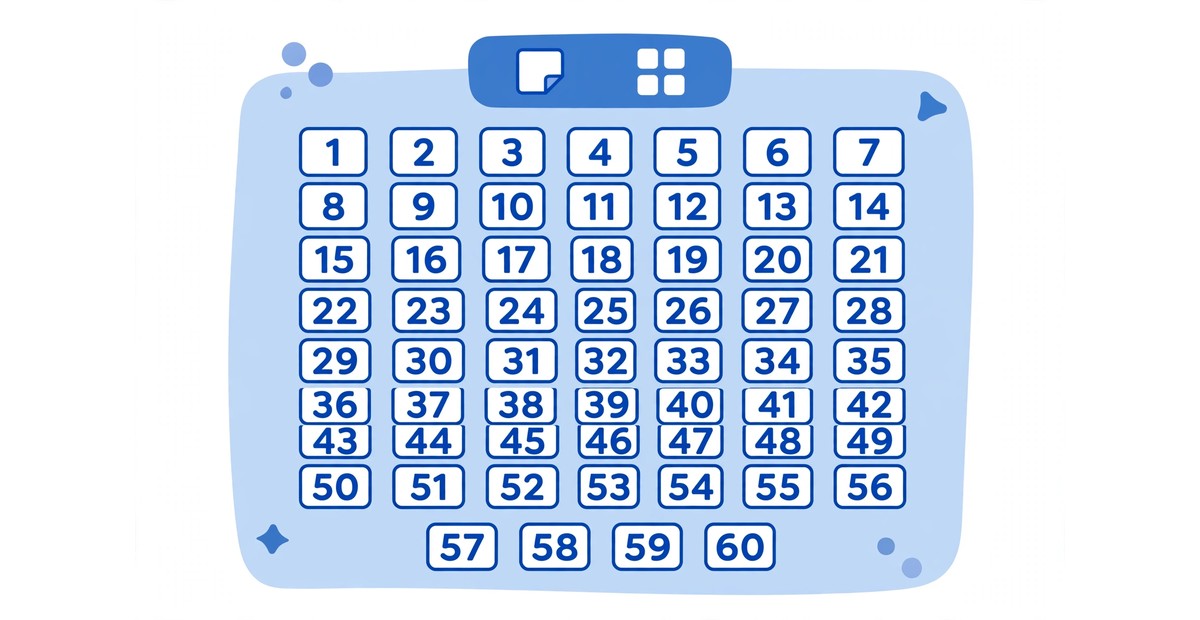
Direct answer: 60 days equals 8 full weeks and 4 extra days, or about 8.57 weeks. Divide 60 by 7 to get 8, with a remainder of 4, so any 60-day period covers 8 complete weeks plus 4 days, no matter which date it starts on.
How Do You Convert 60 Days to Weeks?
One week always has 7 days, so converting days to weeks is a simple division. Divide the number of days by 7. The whole number in the answer is the count of full weeks, and the remainder is the number of extra days.
For 60 days, the steps are:
- Divide 60 by 7. The result is 8.57, rounded to two decimal places.
- Take the whole number, 8, as the count of full weeks.
- Multiply 8 by 7 to get 56 days covered by those full weeks.
- Subtract 56 from 60 to get the remainder, 4 days.
The result is 8 weeks and 4 days. You can check it in reverse: 8 weeks is 56 days, plus 4 days equals 60 days. The same method works for any day count, and it is the method behind every conversion in this guide.
How Many Weeks Are in Nearby Day Counts?
Seeing 60 days next to nearby counts makes the pattern clear. Each extra 7 days adds exactly one full week, while the remainder cycles from 0 to 6:
| Days | Full Weeks + Extra Days | Decimal Weeks |
|---|---|---|
| 7 days | 1 week exactly | 1.00 |
| 14 days | 2 weeks exactly | 2.00 |
| 30 days | 4 weeks + 2 days | 4.29 |
| 45 days | 6 weeks + 3 days | 6.43 |
| 60 days | 8 weeks + 4 days | 8.57 |
| 75 days | 10 weeks + 5 days | 10.71 |
| 90 days | 12 weeks + 6 days | 12.86 |
| 120 days | 17 weeks + 1 day | 17.14 |
Notice that 60 days is not exactly 2 months. Two calendar months can run from 59 to 62 days, depending on which months they are, while 60 days is always exactly 8 weeks and 4 days. If a deadline is stated in days, count in days and weeks, not in months, to avoid a one or two day error.
Worked Examples: 60 Days From Real Dates
Examples help because the weekday shifts with the remainder. Since 60 days is 8 weeks plus 4 days, the end date always falls 4 weekdays after the start date, counting forward through the week.
- From Wednesday, October 28, 2026: add 60 days to reach Sunday, December 27, 2026. Wednesday plus 4 weekdays gives Sunday, and the 8 full weeks in between keep the count exact.
- From Thursday, January 1, 2026: add 60 days to reach Monday, March 2, 2026. Thursday plus 4 weekdays gives Monday.
- From Sunday, March 1, 2026: add 60 days to reach Thursday, April 30, 2026. Sunday plus 4 weekdays gives Thursday.
To find any 60-day end date by hand, add 8 weeks to the start date first, which lands on the same weekday, then add 4 more days. Adding 8 weeks to October 28, 2026, gives December 23, 2026, a Wednesday, and adding 4 days gives Sunday, December 27, 2026.
The same weekday shift applies in every year, including leap years, because the method counts days, not months. A leap day inside the 60-day span changes which calendar date you land on, but it never changes the fact that 60 days is 8 weeks and 4 days.
How Long Is 60 Days in Other Units?
Weeks are the most useful unit for planning, but other units help in different settings:
- Hours: 60 days equals 1,440 hours.
- Months: about 1.97 months, using the average month length of 30.44 days.
- Years: about 0.164 of a standard year, since a standard year has 52 weeks in a year plus 1 day.
- Working days: about 42 to 43 weekdays, depending on where weekends and holidays fall in the span.
For work planning, the weekday count matters most. A 60-day span always contains 8 full Monday to Friday work weeks, plus 4 extra days that may include a weekend, depending on the start date. Count the actual calendar for exact workdays, and use 8 weeks and 4 days for the overall length.
Where Is a 60-Day Period Commonly Used?
Sixty days is a standard length in US work, finance, and everyday planning, which is why the conversion comes up so often:
- Probation periods: many US employers use a 60-day or 90-day probation period for new hires.
- Notice periods: job resignations, lease changes, and contract notices are often set at 30, 60, or 90 days.
- Billing and returns: some US retailers and service providers allow returns, price adjustments, or payment terms within 60 days.
- Travel and visas: some visitor stays and travel plans are measured in 60-day blocks.
- Health and fitness: a 60-day challenge covers just over 8 weeks, which is long enough to show steady progress.
In each case, stating the period as 8 weeks and 4 days helps people plan in weekly blocks. A probation period, for example, can be reviewed at the end of week 4 and again at the end of week 8, with 4 days left for a final decision. For a full-year view of how weeks add up, see our guide to how many weeks are in 2029.
Common Mistakes When Converting Days to Weeks
Three mistakes show up again and again in day-to-week conversions:
- Treating 60 days as exactly 2 months. Months vary from 28 to 31 days, so 2 months is rarely exactly 60 days. Use weeks and days for precision.
- Rounding 8.57 weeks to 9 weeks. Rounding up adds 3 days that are not in the period. Keep the remainder visible as 8 weeks and 4 days.
- Counting both the start and end dates. Adding 60 days to a date means counting 60 days forward, not counting the start date as day 1 and then adding 60 more. The worked examples above use the standard forward-count method.
A quick check avoids all three errors: multiply the full weeks by 7, add the remainder, and confirm the total is 60. If the check fails, the conversion is wrong.
Frequently Asked Questions
How many weeks is 60 days?
60 days is 8 weeks and 4 days, or about 8.57 weeks.
Is 60 days equal to 2 months?
Not exactly. Two calendar months range from 59 to 62 days, while 60 days is always 8 weeks and 4 days. For deadlines, count days, not months.
How do I calculate weeks from days?
Divide the days by 7. The whole number is the full weeks, and the remainder is the extra days. For 60 days, 60 divided by 7 gives 8 with a remainder of 4.
What date is 60 days from October 28, 2026?
60 days from Wednesday, October 28, 2026, is Sunday, December 27, 2026.
How many hours are in 60 days?
60 days equals 1,440 hours, because each day has 24 hours and 60 times 24 is 1,440.
Does a leap year change how many weeks are in 60 days?
No. A leap year adds a day to the calendar year, but any 60-day span is still 8 weeks and 4 days. Questions about week counting can be sent through our contact page.
Leave a Reply