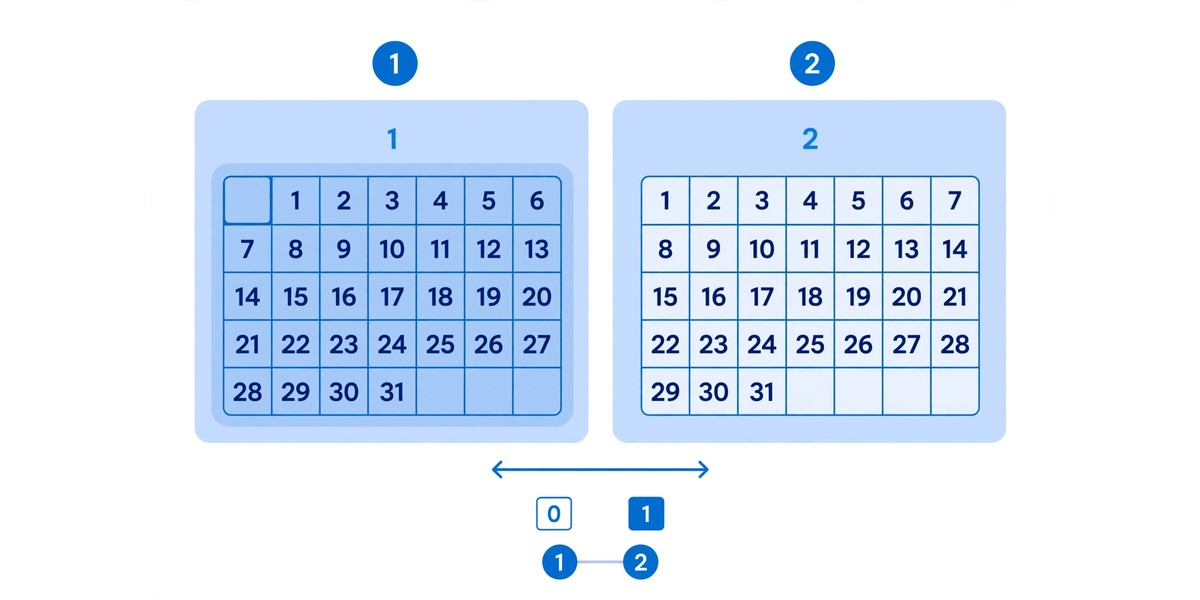
Direct answer: Calendar week numbers are calculated by one of three main methods: ISO 8601, US Sunday-start, or US Monday-start. ISO weeks start on Monday, and week 1 contains the first Thursday of January. US Sunday-start weeks begin on Sunday, with week 1 starting on the first Sunday of January. The method you use decides the number, especially near New Year.
What Is a Week Number?
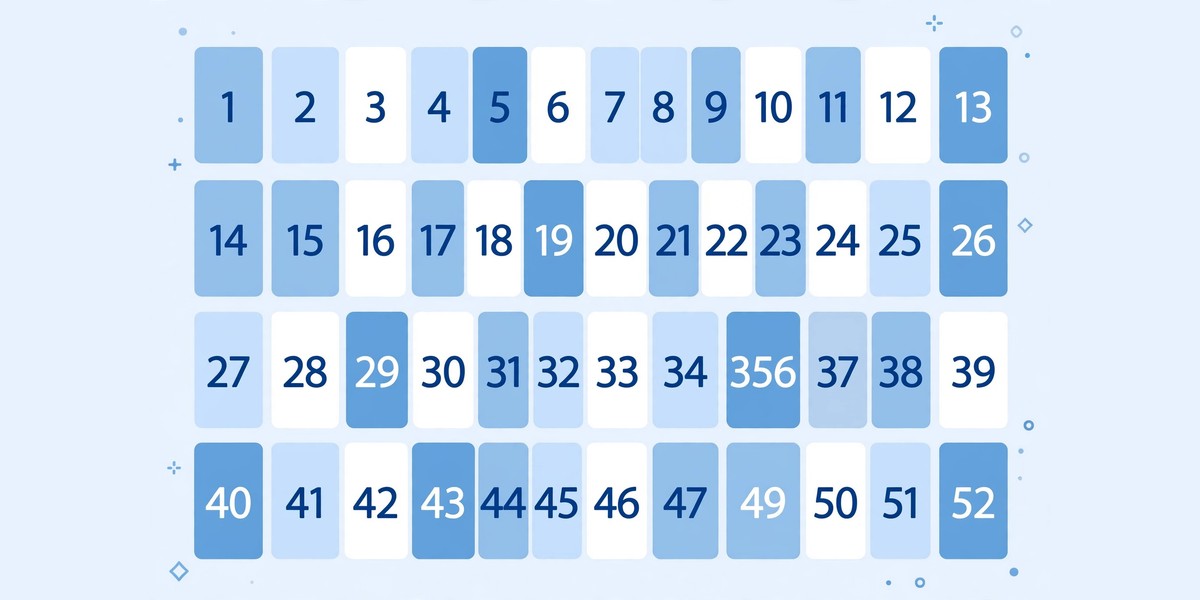
A week number tells you which week of the year a date falls in, counting from 1 up to 52 or 53. Most years have 52 numbered weeks, because a year of 365 days is 52 full weeks in a year plus 1 leftover day. Some years have 53 numbered weeks under ISO rules, including 2026, because the year starts on a Thursday.
Week numbers appear in calendars, planners, payroll software, and project tools. They give every week a short label, such as week 43, instead of a full date range. The problem is that different tools use different counting rules, so the same date can carry two different week numbers.
How Does the ISO 8601 Method Work?
ISO 8601 is the international standard, used across Europe, much of Asia, and in most business software. It has three rules that remove all ambiguity:
- Every week starts on Monday and ends on Sunday.
- Week 1 is the week containing the first Thursday of January. Equivalently, week 1 is the week containing January 4.
- Every week belongs to exactly one year. Days at the start of January can belong to the previous ISO year, and days at the end of December can belong to the next ISO year.
Under these rules, ISO week 1 of 2026 starts on Monday, December 29, 2025, because that week contains Thursday, January 1, 2026. At the other end of the year, ISO week 53 of 2026 runs from Monday, December 28, 2026 to Sunday, January 3, 2027. That is why 2026 is a 53-week ISO year: it starts on a Thursday, so the first and last weeks stretch across the calendar boundary.
A year has 53 ISO weeks when it starts on a Thursday, or when it is a leap year that starts on a Wednesday. All other years have 52 ISO weeks. This rule is exact, so software can compute ISO week numbers without any judgment calls.
How Does the US Sunday-Start Method Work?
The common US method matches the layout of most American printed calendars, where Sunday is the first column. Its rules are simpler but less tidy:
- Weeks start on Sunday.
- Week 1 starts on the first Sunday of January. In 2026, that is Sunday, January 4.
- Days before the first Sunday are week 0. In 2026, January 1 to 3 fall in week 0.
This method is common in US calendars and programming tools. Its weakness is week 0: the first few days of January get a number that looks like an error.
For example, Sunday, October 25, 2026 starts US week 43, because it is the 43rd Sunday-start week counting from January 4. Under ISO rules, the same Sunday is the last day of ISO week 43, which started on Monday, October 19. The two methods agree on the number that day, but for a different reason, and they often disagree by one.
How Does the US Monday-Start Method Work?
A third method keeps Monday as the first day but counts more simply than ISO. Weeks start on Monday, and week 1 starts on the first Monday of January. Days before that Monday are week 0. In 2026, the first Monday is January 5, so January 1 to 4 fall in week 0 under this method.
This method appears in some planners, scheduling tools, and spreadsheet functions. It is easy to explain, but it shares the US method’s week 0 problem, and it can disagree with ISO by a full week at the start of the year. For instance, Monday, January 5, 2026 is week 1 under this method, but ISO already counted the week starting December 29, 2025 as ISO week 1.
The table below compares all three methods on key dates in and around 2026. Notice how the methods agree in the middle of the year but split apart at the boundaries.
| Date | Day | ISO week | US Sunday-start week | US Monday-start week |
|---|---|---|---|---|
| December 29, 2025 | Monday | Week 1 of 2026 | Week 52 of 2025 | Week 52 of 2025 |
| January 1, 2026 | Thursday | Week 1 of 2026 | Week 0 | Week 0 |
| January 4, 2026 | Sunday | Week 1 of 2026 | Week 1 | Week 0 |
| January 5, 2026 | Monday | Week 2 of 2026 | Week 2 | Week 1 |
| October 23, 2026 | Friday | Week 43 | Week 42 | Week 43 |
| October 25, 2026 | Sunday | Week 43 | Week 43 | Week 43 |
| December 28, 2026 | Monday | Week 53 | Week 52 | Week 52 |
| December 31, 2026 | Thursday | Week 53 | Week 52 | Week 52 |
| January 4, 2027 | Monday | Week 1 of 2027 | Week 1 of 2027 | Week 1 of 2027 |
Read the October 23 row carefully: that Friday sits in ISO week 43 and US Monday-start week 43, but only US Sunday-start week 42, because the US Sunday week containing it started on Sunday, October 18. Two days later, on Sunday, October 25, all three methods agree on week 43. Small shifts like this are why a week number without a stated method can confuse a team.
Which Method Should You Use?
The right method depends on your audience and tools. Use ISO 8601 when you work across countries, or when payroll or reporting needs a standard that never produces week 0.
Use the US Sunday-start method when your audience reads American printed calendars, or when your tool already uses it and changing it would break existing records. Use the US Monday-start method when your team plans Monday to Friday but your tool does not offer ISO counting. In every case, state the method once in shared documents, such as “week numbers are ISO weeks,” so readers do not have to guess.
To remove ambiguity, write the date range next to the week number, such as “week 2 (January 5 to 11, 2026),” so every reader sees the same week.
For the related question of how many working weeks a year contains once holidays are removed, see How Many Work Weeks Are in 2026? That guide counts 261 weekdays in 2026 and 50 work weeks after federal holidays. For general background on this site, see the about page.
Frequently Asked Questions
How are calendar week numbers calculated?
They are calculated by ISO 8601, US Sunday-start, or US Monday-start rules, which differ in the first day of the week and in how week 1 is defined.
What is ISO week 1?
ISO week 1 is the week containing the first Thursday of January, which is the same as the week containing January 4.
Why does 2026 have 53 ISO weeks?
Because 2026 starts on a Thursday, ISO week 1 starts on December 29, 2025 and ISO week 53 ends on January 3, 2027, giving 53 numbered weeks.
What is US week 0?
US week 0 covers the days before the first Sunday (or first Monday) of January, which belong to no full week under the US counting methods.
Why do two calendars show different week numbers?
Because they use different methods. One may use ISO Monday-start rules while the other uses US Sunday-start rules, which differ by one week near the start and end of the year.
Which week number system does the United States use?
There is no single official US system. American printed calendars commonly use Sunday-start weeks, while business software often uses ISO weeks, so always check which method a tool uses.
Leave a Reply