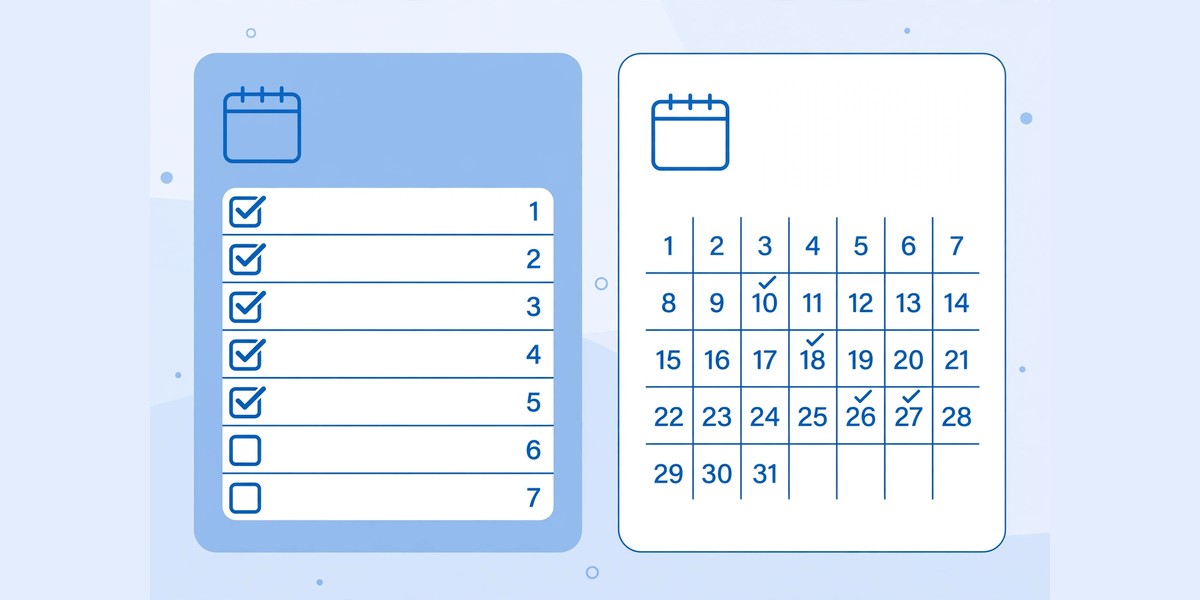
Direct answer: Weeks are better for short-term plans, habits, and deadlines, while months are better for bills, budgets, and long-term goals. The reason is simple: a week is always exactly 7 days, but a month runs 28 to 31 days, so weekly plans stay consistent while monthly plans shift. The smartest approach is to use both, with months for milestones and weeks for action steps.
Why Do Weeks and Months Measure Time Differently?
A week is a fixed unit. Every week has exactly 7 days, no exceptions, so 10 weeks is always 70 days. A month is a calendar unit, and its length changes: February has 28 days in a common year, while January, March, May, July, August, October, and December have 31. That variation makes month-based math fuzzy, while week-based math stays exact.
The average month holds 4.345 weeks, which is 52.14 weeks in a year divided by 12. But no single month is exactly 4.345 weeks long, so any plan that treats every month as “4 weeks” slowly drifts off schedule. Over a full year, that shortcut loses about 1.7 weeks of real time.
| Month | Days | Exact Weeks |
|---|---|---|
| January | 31 | 4.43 |
| February | 28 (29 in leap years) | 4.00 (4.29) |
| March | 31 | 4.43 |
| April | 30 | 4.29 |
| May | 31 | 4.43 |
| June | 30 | 4.29 |
| July | 31 | 4.43 |
| August | 31 | 4.43 |
| September | 30 | 4.29 |
| October | 31 | 4.43 |
| November | 30 | 4.29 |
| December | 31 | 4.43 |
This is why the total number of weeks in a year is 52 plus a leftover day or two, rather than a clean 52. Months and weeks simply do not divide evenly into each other.
When Should You Plan in Weeks?
Weekly planning shines whenever consistency and momentum matter. Because every week is identical in length, weekly targets are easy to compare, repeat, and track. Weekly planning works best for:
- Fitness and habits: a 12-week training program has 12 equal blocks, while “3 months” could mean 89 to 92 days depending on which months you pick.
- Study and courses: a 15-week college semester is a standard unit in the United States, so weekly syllabi line up neatly.
- Work sprints: software and marketing teams plan in 1-week or 2-week sprints because the fixed length makes progress easy to measure.
- Countdowns: counting down “8 weeks until vacation” feels concrete, while “2 months” hides whether that means 59 or 62 days.
- Debt payoff and savings challenges: weekly payments, such as a 52-week money challenge, build momentum faster than monthly ones.
The main drawback is horizon: planning 52 separate weeks at once is overwhelming, so weekly plans work best inside a monthly or quarterly frame.
When Should You Plan in Months?
Monthly planning wins whenever the real world runs on months. Most of adult life is billed, paid, and reviewed by the month, so monthly plans match reality. Monthly planning works best for:
- Rent and mortgages: housing payments are monthly in the United States, so a monthly budget maps directly to cash flow.
- Subscriptions and bills: utilities, phone plans, and streaming services all bill monthly.
- Salary and savings goals: many workers are paid monthly or semimonthly, and retirement contributions are usually set as a monthly amount.
- Long-term goals: a 6-month emergency fund or a 12-month business plan reads more clearly in months than in 26 or 52 weekly chunks.
- Seasonal milestones: quarterly reviews, tax deadlines, and school terms all sit naturally on a monthly calendar.
The main drawback is precision: a “monthly” task can drift, since the month you start in may be 3 days longer or shorter than the month you finish in.
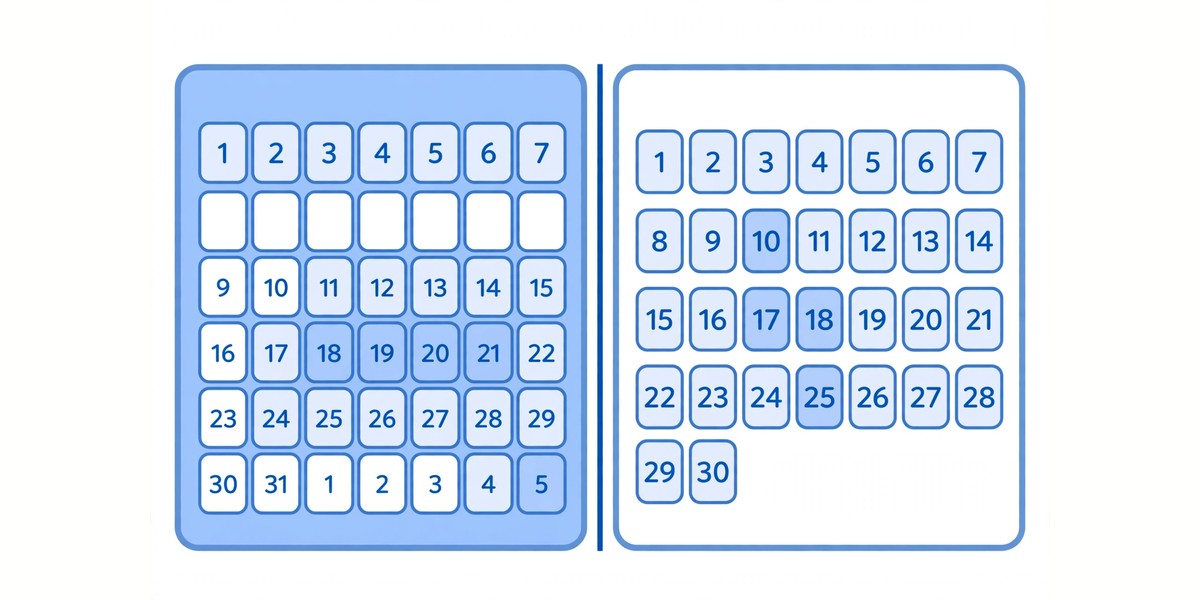
Weeks vs Months: Side-by-Side Comparison
| Feature | Weeks | Months |
|---|---|---|
| Length | Always 7 days | 28 to 31 days |
| Per year | 52.14 | 12 |
| Best for | Habits, sprints, countdowns | Bills, budgets, long goals |
| Tracking ease | Very easy, equal blocks | Easy, matches billing cycles |
| Main weakness | Too granular for long horizons | Uneven length causes drift |
How Do You Convert Between Weeks and Months?
Use these two formulas for quick conversion:
- Months to weeks: multiply months by 4.345. For example, 6 months equals about 26.09 weeks.
- Weeks to months: divide weeks by 4.345. For example, 20 weeks equals about 4.6 months.
For rough planning, “4 weeks per month” is fine, but remember it understates every year by roughly 1.7 weeks. If a deadline truly matters, use the exact day count instead: multiply weeks by 7, or count the calendar days in the months involved.
Can You Combine Both Units?
Yes, and the best planners do. A proven hybrid method is the 12-week year approach: set a goal for a 12-week block (roughly a quarter), then break it into weekly targets and review it monthly. A practical setup looks like this:
- Set one monthly milestone, such as saving 500 dollars or reading 2 books.
- Split the milestone into 4 weekly actions, such as saving 125 dollars per week.
- Review progress every Sunday, and adjust the next week’s actions if you fall behind.
- Reset the milestone at the start of each new month.
This keeps the precision of weeks and the real-world fit of months. For a sense of how these units scale up, see our guide on how many weeks are in a millennium, where the same conversion logic covers 1,000 years. If you want help applying either unit to your own schedule, our contact page is the place to reach us.
Frequently Asked Questions
How many weeks are in a month?
On average, a month has 4.345 weeks. Individual months range from exactly 4 weeks (February in a common year) to 4.43 weeks (a 31-day month).
Is it better to set goals weekly or monthly?
Weekly goals build momentum because every week is the same length, while monthly goals fit bills and salaries better. Use weekly actions inside monthly milestones for the best of both.
Why does planning by months cause drift?
Because months run 28 to 31 days, treating every month as 4 weeks loses about 1.7 weeks per year. The drift comes from the leftover days that make a year 52 weeks plus 1 or 2 days.
How many weeks are in 6 months?
Six months equals about 26.09 weeks on average, using the 4.345 weeks-per-month average. The exact figure depends on which 6 calendar months you count.
What is the 12-week year method?
It is a planning method that treats 12 weeks as a “year”: you set a goal for a 12-week block, break it into weekly actions, and review progress each week. It combines weekly precision with a quarterly horizon.
Do businesses plan in weeks or months?
Most businesses do both: budgets and reporting run monthly or quarterly, while production, retail calendars, and project sprints often run weekly. US retailers even use special 52-week or 53-week fiscal calendars.
Leave a Reply