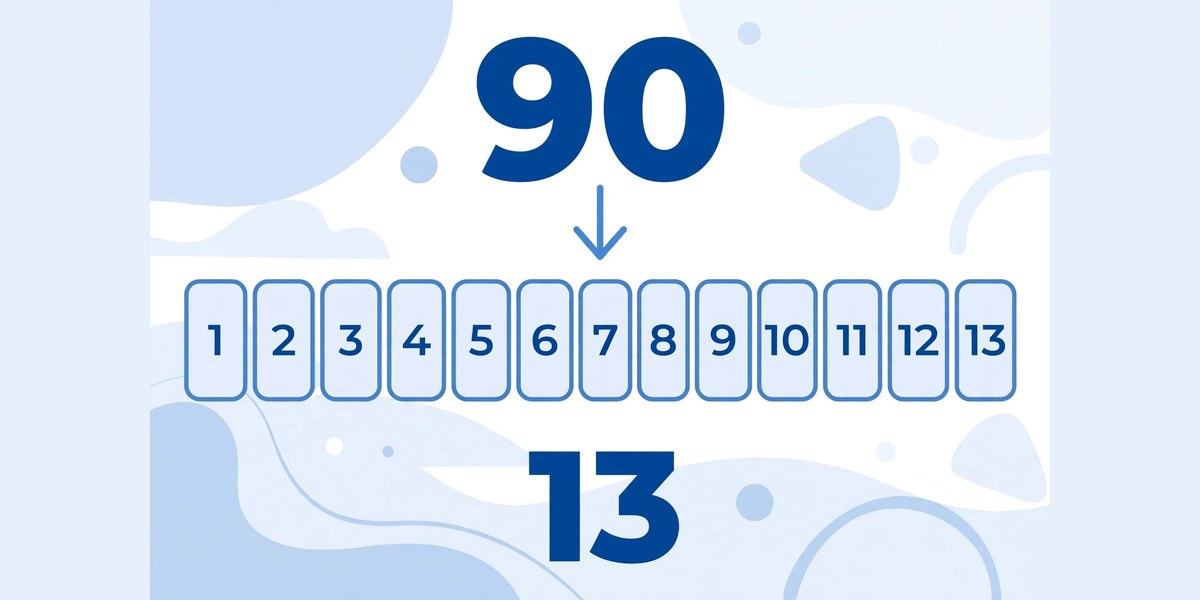
Direct answer: There are 12 full weeks in 90 days, with 6 days left over. The math is simple: divide 90 by 7 to get 12.857, so 90 days equals 12 weeks and 6 days. This conversion works for any 90-day period, no matter where it starts on the calendar.
How Do You Convert 90 Days to Weeks?
Converting days to weeks takes one step: divide the number of days by 7. For 90 days, the calculation looks like this:
- 90 / 7 = 12.857 weeks
- 12 full weeks = 84 days
- 90 – 84 = 6 leftover days
So 90 days is 12 weeks and 6 days. The 6 extra days mean that a 90-day period starting on a Monday will end on a Sunday of the 13th week. This same division method converts any day count into weeks, which is why the number of weeks in a year comes out to 52 full weeks plus a leftover day or two.
Is 90 Days the Same as 3 Months?
Not exactly, and this is a common point of confusion. People often say “90 days” when they mean “3 months,” but the two are only equal when the three months add up to exactly 90 days.
| 3-Month Period | Total Days | Equals 90 Days? |
|---|---|---|
| January through March (non-leap year) | 90 | Yes, exactly |
| January through March (leap year) | 91 | No, 1 day over |
| February through April (non-leap year) | 89 | No, 1 day short |
| June through August | 92 | No, 2 days over |
| October through December | 92 | No, 2 days over |
Because months range from 28 to 31 days, three consecutive months total anywhere from 89 to 92 days. Only January through March in a non-leap year hits exactly 90. Contracts and policies that say “90 days” usually mean a precise 90-day count, not “three months,” so always count the actual days.

Where Do 90-Day Periods Show Up in Real Life?
The 90-day window is one of the most common time periods in American work and finance, which is why knowing it equals 12 weeks and 6 days comes in handy:
- Job probation periods: many US employers use a 90-day introductory period, roughly 12 working weeks, before benefits vest.
- Credit card grace periods and disputes: federal rules give consumers up to 60 days to dispute a charge, but many issuers extend reviews toward the 90-day mark.
- Mortgage forbearance: initial forbearance plans often run 90 days, or about 12 weeks, before the lender reviews the account.
- Quarterly business goals: a fiscal quarter is about 13 weeks, so 90-day plans sit just under a full quarter at 12 weeks and 6 days.
- Health insurance waiting periods: the Affordable Care Act caps employer waiting periods at 90 days, close to 13 weeks.
How Many 90-Day Periods Fit in a Year?
A standard 365-day year holds 4 full 90-day periods with 5 days left over (365 – 360 = 5). A leap year holds the same 4 periods with 6 days left over. In week terms, a year is 52 weeks plus 1 or 2 days, so four 90-day periods equal 48 weeks and 24 days, leaving roughly 3 and a half weeks unaccounted for.
This is the same kind of leftover-day arithmetic that explains the full-year picture in our 2028 year breakdown, where the leap day adds one extra day to the yearly total.
Quick Conversion Table: Days to Weeks Around 90
| Days | Weeks + Leftover Days | Decimal Weeks |
|---|---|---|
| 84 | 12 weeks exactly | 12.0 |
| 85 | 12 weeks + 1 day | 12.14 |
| 86 | 12 weeks + 2 days | 12.29 |
| 87 | 12 weeks + 3 days | 12.43 |
| 88 | 12 weeks + 4 days | 12.57 |
| 89 | 12 weeks + 5 days | 12.71 |
| 90 | 12 weeks + 6 days | 12.86 |
| 91 | 13 weeks exactly | 13.0 |
Notice how close 90 days sits to a clean 13 weeks: just one day short. If a project timeline is built in whole weeks, rounding 90 days up to 13 weeks is usually the safe choice.
Worked Example: Counting 90 Days From Today
Say a 90-day return policy starts on Wednesday, October 21, 2026. Count forward 12 full weeks to land on Wednesday, January 13, 2027, then add the 6 leftover days: Thursday the 14th, Friday the 15th, Saturday the 16th, Sunday the 17th, Monday the 18th, and Tuesday, January 19, 2027. The 90th day falls on Tuesday, January 19, 2027.
The shortcut: add 12 weeks to the start date, then add 6 more days. Or simply move the date forward 3 months and adjust for the months’ actual lengths, which is what calendar apps do automatically. For general questions about how we handle dates and data, see our contact page.
How to Plan a 90-Day Goal in Weekly Milestones
Because 90 days is 12 weeks and 6 days, it maps neatly onto a 12-week planning cycle with a short buffer week at the end. Coaches, fitness programs, and study plans often structure 90-day goals exactly this way:
| Phase | Weeks | Focus |
|---|---|---|
| Foundation | Weeks 1-3 | Build the habit and set baselines |
| Build | Weeks 4-8 | Increase effort and track steady progress |
| Push | Weeks 9-12 | Peak effort toward the target |
| Review | 6 remaining days | Measure results and plan the next cycle |
This structure works because whole weeks are easier to track than odd day counts. Whether the goal is saving money, training for a race, or learning a skill, thinking in 12 weekly blocks keeps the plan simple, and the 6 leftover days give you a built-in review window before the next 90-day cycle starts.
Frequently Asked Questions
How many weeks are in 90 days?
90 days equals 12 full weeks plus 6 extra days, or about 12.86 weeks.
Is 90 days exactly 3 months?
Not always. Three consecutive months range from 89 to 92 days depending on which months they are. Only January through March in a non-leap year totals exactly 90 days.
How many weeks are in 90 business days?
90 business days, excluding weekends, equals 18 calendar weeks, since 5 business days fit into each week (90 / 5 = 18).
What is 90 days in months and weeks?
90 days is roughly 2.96 months, or 12 weeks and 6 days. It sits just one day short of 13 full weeks.
How do I calculate weeks from any number of days?
Divide the days by 7. The whole number is the count of full weeks, and multiplying it back by 7 and subtracting from the total gives the leftover days.
How many 90-day periods are in a year?
Four 90-day periods fit into a year, with 5 days left over in a standard year or 6 in a leap year.
Leave a Reply