
A lunar year has 354 days, which equals 50 weeks and 4 days. That makes it about 11 days shorter than a 365-day solar year. Lunar calendars, including the Islamic Hijri calendar, measure the year with 12 moon cycles of about 29.53 days each, and leap lunar years add one extra day for a 355-day year.
Most people live by the solar calendar, so the lunar year feels unfamiliar. Yet it sets the dates of Ramadan and the Chinese New Year and explains why some holidays drift through the seasons. This guide converts the lunar year to weeks and shows how different lunar calendars handle the math.
How Long Is a Lunar Year in Weeks?
Dividing 354 by 7 gives 50.57, or 50 complete weeks with 4 days left over (50 times 7 = 350). So a common lunar year is 50 weeks and 4 days.
Leap lunar years have 355 days, or 50 weeks and 5 days. Here is how the main year types compare:
| Year type | Days | Weeks and days | Decimal weeks |
|---|---|---|---|
| Common lunar year | 354 | 50 weeks and 4 days | 50.57 |
| Leap lunar year | 355 | 50 weeks and 5 days | 50.71 |
| Common solar year | 365 | 52 weeks and 1 day | 52.14 |
| Leap solar year | 366 | 52 weeks and 2 days | 52.29 |
| Chinese leap year (13 months) | 383 – 385 | 54 weeks 5 days to 55 weeks | 54.71 – 55.00 |
The gap between a common lunar year and a common solar year is exactly 11 days: 365 minus 354. That 11-day difference drives everything else in this article, from drifting holidays to leap-month calendars.
Why Is a Lunar Year Shorter Than a Solar Year?
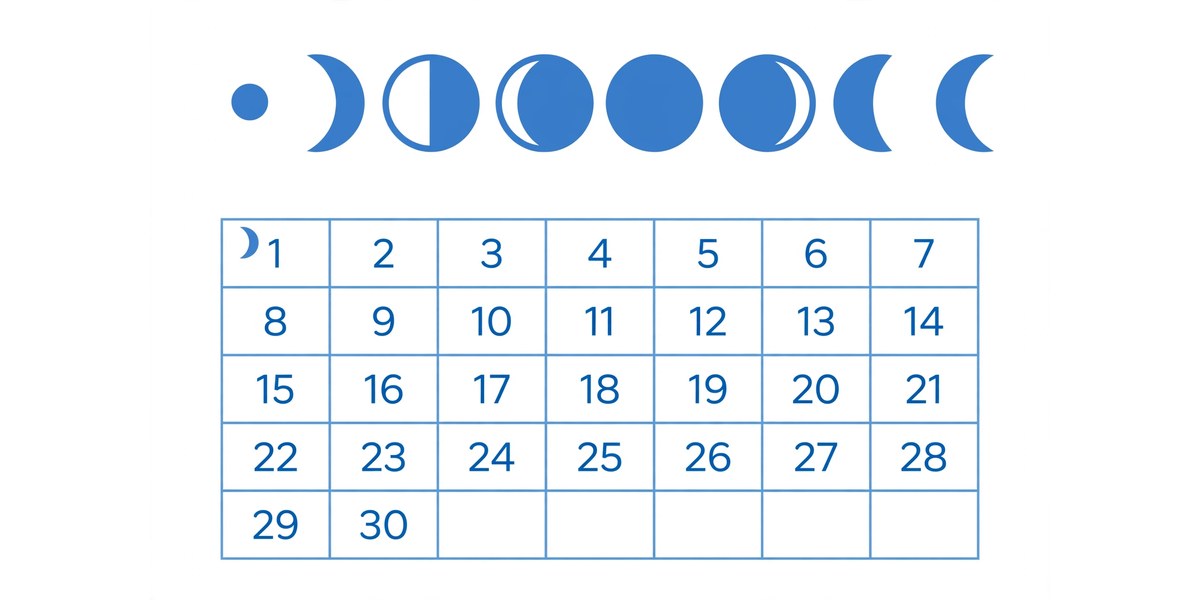
A lunar month follows the Moon’s phases. One full cycle from new moon to new moon, called a synodic month, lasts 29.53059 days. Twelve months give 12 times 29.53059 = 354.367 days. Lunar calendars round this to 354 days in common years.
A solar year follows the Earth’s orbit around the Sun: 365.2425 days. The difference is 365.2425 minus 354.367 = 10.875 days, roughly 11 days. So the lunar year is not “missing” anything; it simply tracks a different clock. The Moon laps its phases about 11 days before the Earth finishes its orbit, and lunar calendars accept that drift as part of the design.
This is the mirror image of the solar calendar most Americans use, where a standard year is 52 weeks and 1 day.
Which Calendars Use Lunar Years?
Several major calendar systems are lunar or lunisolar, and they handle the 354-day year differently:
- The Islamic Hijri calendar: purely lunar, with 12 months alternating 29 and 30 days. It never adds a leap month, so the year stays at 354 or 355 days. The year 1448 AH began on June 16, 2026, and the new year drifts about 11 days earlier in the Gregorian calendar each year.
- The Chinese calendar: lunisolar. Regular years have 12 lunar months (353 to 355 days), while leap years insert a 13th month, stretching to 383 to 385 days. The Chinese year that began on February 17, 2026 lasted exactly 354 days, or 50 weeks and 4 days.
- The Hebrew calendar: lunisolar. Regular years run 353, 354, or 355 days, and leap years add a second month of Adar, reaching 383 to 385 days. Hanukkah 2026 falls from sundown on December 4 to nightfall on December 12.
- Hindu calendars: mostly lunisolar, with lunar months and periodic leap months (adhika maas) inserted roughly every 32 to 33 months to keep festivals aligned with the seasons.
What Happens in a Leap Lunar Year?
Lunar leap years work differently from solar ones. A solar leap year adds one day (February 29). A lunar leap year adds either one day or a whole month, depending on the calendar:
- Islamic calendar: in a 30-year cycle, 11 of the 30 years are leap years with 355 days instead of 354. The extra day goes to the final month, Dhu al-Hijja, which gets 30 days instead of 29.
- Chinese calendar: leap years add an entire leap month (run yue), making 13 months. These years last 383 to 385 days, or roughly 54 weeks and 5 days to a full 55 weeks. They occur about 7 times in every 19 years.
- Hebrew calendar: leap years add the month of Adar I, giving 13 months and 383 to 385 days. This happens 7 times in every 19-year cycle, the same rhythm as the Chinese calendar.
How Fast Does a Lunar Year Drift Against the Solar Calendar?
Any date fixed in a purely lunar calendar arrives about 11 days earlier each Gregorian year. Ramadan is the best-known example: it moves steadily backward through the seasons, cycling through winter, autumn, summer, and spring over a few decades.
The drift is remarkably regular. After 33 lunar years the total drift is about 359 days, nearly a full solar year, giving the classic rule of thumb: 33 lunar years are roughly equal to 32 solar years (11,694 days versus 11,688 days).
Lunisolar calendars avoid this drift by design. Their leap-month systems pull the calendar back into alignment, so festivals stay in roughly the same season: Chinese New Year always falls between January 21 and February 20, and the Hebrew month of Nisan always lands in spring.
For a holiday countdown that lives on the solar calendar instead, see how many weeks are left until Christmas, where the date never moves.
How Do You Convert a Lunar Year to Weeks?
Use this simple three-step method for any lunar year length:
- Divide the day count by 7. For a common lunar year: 354 / 7 = 50.57.
- Take the whole number. That is 50 complete weeks.
- Find the remainder. 50 times 7 = 350. 354 minus 350 = 4 leftover days.
That gives 50 weeks and 4 days for a common lunar year. For a 355-day leap lunar year, the same method gives 50 weeks and 5 days. For a 384-day Chinese leap year, it gives 54 weeks and 6 days (54 times 7 = 378, and 384 minus 378 = 6).
Frequently Asked Questions
How many weeks are in a lunar year?
A common lunar year of 354 days equals 50 weeks and 4 days. A leap lunar year of 355 days equals 50 weeks and 5 days.
Why does the Islamic calendar have fewer days than the Gregorian calendar?
The Islamic calendar is purely lunar, tracking 12 moon cycles of about 29.53 days each for a 354-day year. It never adds leap months, so it runs about 11 days shorter than the 365-day solar Gregorian year.
How many days are in 12 lunar months exactly?
Twelve synodic months of 29.53059 days each total 354.367 days. Calendars round this to 354 days in common years and 355 in leap years.
Do lunar years have leap years?
Yes, but they work differently by calendar. The Islamic calendar adds one day in 11 of every 30 years, while the Chinese and Hebrew calendars add a whole leap month about 7 times every 19 years.
How long until a lunar date returns to the same solar date?
About 33 lunar years, which roughly equals 32 solar years. Because the lunar year is 11 days shorter, a lunar date drifts backward through the solar calendar and takes about 33 years to come full circle.
Is a lunar year the same as 12 calendar months?
Not exactly. Twelve lunar months are 354 days, while 12 Gregorian calendar months are 365 days (or 366 in a leap year). The 11-day gap is why lunar holidays like Ramadan move through the seasons. You can read more about our approach to calendar explainers on the contact us page.
Leave a Reply