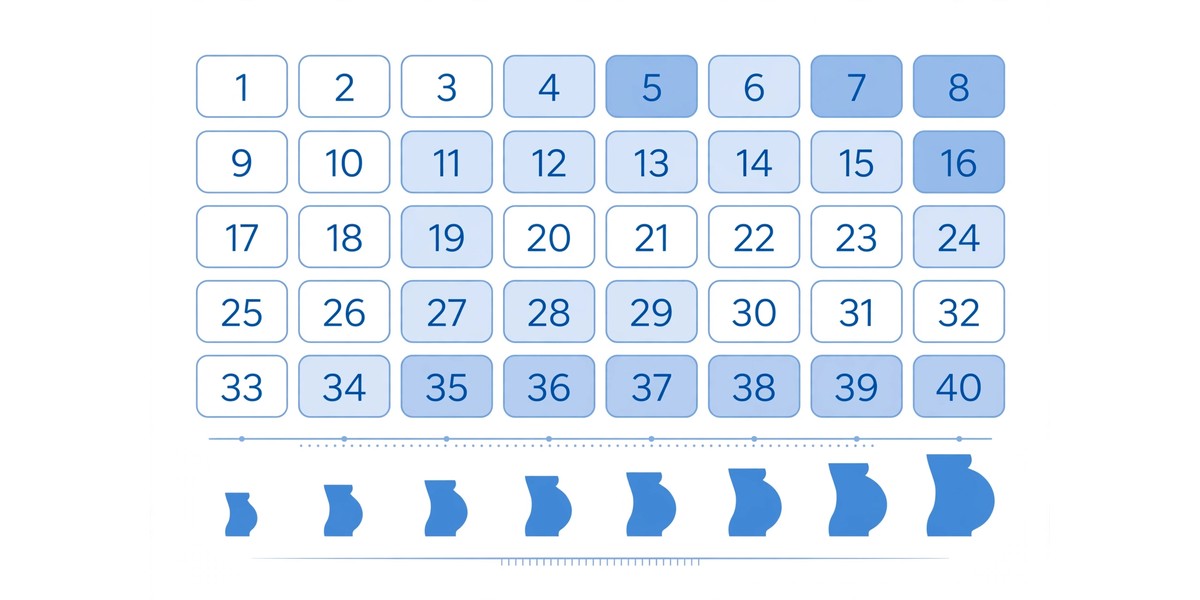
A full-term pregnancy lasts 40 weeks, counted from the first day of your last menstrual period. That equals 280 days, or exactly 40 seven-day weeks. Because ovulation usually happens about two weeks after that starting date, the baby’s true age at birth is closer to 38 weeks. Most babies arrive within two weeks of the 40-week due date.
Why Is Pregnancy Measured in Weeks?
Weeks are the standard unit for tracking pregnancy because fetal development moves fast. A lot changes in seven days, so counting in weeks gives doctors and parents a precise timeline. Each week has known milestones, from the first heartbeat around week 6 to lung maturity near week 36.
Weeks work better than months for tracking pregnancy. A month spans 28 to 31 days, a wide range when organs are forming, while a week is a stable, comparable unit. That is why every prenatal chart, ultrasound report, and medical guideline in the United States uses gestational age counted in weeks, much like the standard weeks in a year that calendars use.
How Do Doctors Calculate Pregnancy Weeks?
Doctors count pregnancy from the first day of your last menstrual period, abbreviated LMP. This is called gestational age. It is a convention, not a biological claim: conception usually happens about 14 days after the LMP, during ovulation, but the LMP date is known while the conception date usually is not.
Here is how the counting works:
- Week 1 begins on the first day of the last period.
- Week 2 is when ovulation and fertilization typically occur.
- Weeks 3 to 8 cover the embryonic stage, when major organs form.
- Week 9 onward is the fetal stage, a period of growth and refinement.
So a woman who is “6 weeks pregnant” actually conceived about 4 weeks earlier. The two-week gap surprises many people, but it is built into the system on purpose, because the LMP is the one date a patient can usually report with confidence.
Early ultrasounds refine this dating. A first-trimester ultrasound can date a pregnancy within about five days, and doctors will adjust the due date if the scan disagrees with the LMP by more than that margin.
What Does 40 Weeks Mean in Days and Months?
Forty weeks equals 280 days. That is 9 calendar months plus about 7 days, which is why pregnancy is often summarized as “nine months.” The math checks out:
| Unit | Count |
|---|---|
| Weeks | 40 |
| Days | 280 (40 x 7) |
| Calendar months | About 9 months and 1 week |
| Lunar months (28 days) | 10 exactly |
The common “nine months” phrase undersells the true 280-day span by about a week.
The related post on what a 52-53 week year in retail is shows another place where the week count of a “year” depends on the calendar convention you choose.
What Are the Pregnancy Trimesters in Weeks?
Pregnancy is divided into three trimesters, each with its own weeks and milestones:
| Trimester | Weeks | What happens |
|---|---|---|
| First | 1 to 13 | Fertilization, implantation, organ formation, first heartbeat |
| Second | 14 to 27 | Rapid growth, first movements felt, anatomy scan around week 20 |
| Third | 28 to 40 | Brain and lung maturation, weight gain, preparation for birth |
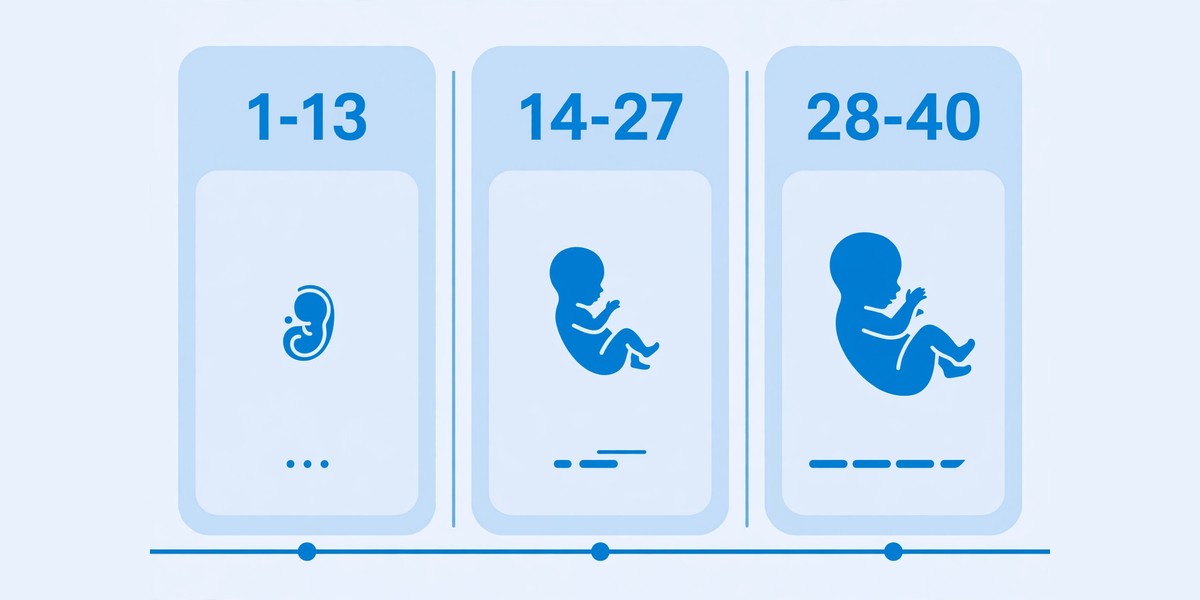
The first trimester carries the highest risk of miscarriage, which is why many people wait until week 12 to share the news. The second trimester is often the most comfortable: nausea fades and energy returns. The third trimester brings the final growth sprint, with the baby gaining roughly half a pound per week in the last month.
Each trimester also has its own testing schedule. First-trimester screening happens around weeks 11 to 14, the anatomy ultrasound around weeks 18 to 22, and glucose screening around weeks 24 to 28. Knowing which week you are in tells you which appointment comes next.
What Counts as a Full-Term Pregnancy?
The American College of Obstetricians and Gynecologists defines delivery timing in precise week ranges:
| Category | Week range |
|---|---|
| Early term | 37 weeks 0 days through 38 weeks 6 days |
| Full term | 39 weeks 0 days through 40 weeks 6 days |
| Late term | 41 weeks 0 days through 41 weeks 6 days |
| Postterm | 42 weeks 0 days and beyond |
A birth before 37 weeks is classified as preterm. Research shows that babies born at 39 to 40 weeks have the best average outcomes, which is why elective deliveries are generally not scheduled before 39 weeks in US hospitals unless there is a medical reason.
About 60 percent of full-term births happen within two weeks of the due date, and only around 5 percent arrive exactly on it. The due date is a midpoint of a normal range, not an appointment.
How Do You Calculate a Due Date?
The standard method is Naegele’s rule: add 280 days to the first day of the last menstrual period. A quick mental version is to subtract 3 months, add 7 days, and add 1 year. Here is a worked example:
- First day of last period: January 1, 2026.
- Subtract 3 months: October 1, 2025.
- Add 7 days: October 8, 2025.
- Add 1 year: October 8, 2026.
The due date is Thursday, October 8, 2026. Checking by direct addition, January 1 plus 280 days also lands on October 8, 2026, which confirms the rule. If you want to cross-check any date arithmetic like this, the date math on this site’s about page explains the calendar conventions used throughout.
After a first-trimester ultrasound, the sonographer may adjust the due date by a few days. The scan-based date then replaces the LMP-based date for the rest of the pregnancy, because it reflects actual fetal size rather than an assumed ovulation day.
Why Are So Many Babies Born “Late” or “Early”?
Only about 1 in 20 babies arrives on the estimated due date. Healthy pregnancies commonly end anywhere from 37 to 42 weeks, and first pregnancies tend to run slightly longer than later ones. “Overdue” technically begins at 42 weeks, and most providers discuss induction by 41 weeks if labor has not started.
The week-based system makes this variation easy to communicate. Saying “she is 39 weeks and 4 days” tells the care team exactly where she stands relative to every guideline, milestone, and test window.
Frequently Asked Questions
How many weeks is 9 months pregnant?
Nine calendar months is about 39 weeks, so a “nine months pregnant” woman is usually in week 36 to 40 of the 40-week count. The common “nine months” phrase undersells the true 280-day span by about a week.
Is 37 weeks full term?
No, 37 weeks is classified as early term. Full term begins at 39 weeks and 0 days under current ACOG definitions, though babies born at 37 to 38 weeks are healthy in the large majority of cases.
Why is pregnancy 40 weeks if conception is at week 2?
The count starts at the last menstrual period because that date is known and verifiable. Conception typically follows about two weeks later, so the embryo’s true age is about 38 weeks at a 40-week due date.
Can a pregnancy go past 42 weeks?
It can, but it is rare in the US because providers usually recommend induction by 41 to 42 weeks. Beyond 42 weeks the placenta’s efficiency can decline, so close monitoring or delivery is advised.
How many days is 40 weeks?
Exactly 280 days. That is the basis of Naegele’s rule for due dates: last menstrual period plus 280 days.
Do twins change the week count?
The 40-week framework stays the same, but twins are often delivered earlier, typically around 37 to 38 weeks for uncomplicated twin pregnancies, because the risks of continuing rise after that point.
Leave a Reply