
No, not all months have 4 weeks. Only February in a non-leap year is exactly 4 weeks long (28 days). Every other month has extra days: 30-day months are 4 weeks and 2 days, and 31-day months are 4 weeks and 3 days. The idea that a month equals 4 weeks is a handy approximation, but it is off by 2 to 3 days every single month.
This myth causes real confusion in payroll, rent math, and project planning. If you budget a “monthly” amount by multiplying a weekly cost by 4, you will come up short every month except February. This guide shows exactly how many weeks each month holds, explains where the 4-week myth comes from, and gives you the right numbers to use instead.
How Many Weeks Are in Each Month?
Four weeks equals exactly 28 days, so any month longer than 28 days holds more than 4 weeks. Here is the full breakdown for a standard year of 365 days.
| Month | Days | Weeks and days | Decimal weeks |
|---|---|---|---|
| January | 31 | 4 weeks + 3 days | 4.43 |
| February | 28 | Exactly 4 weeks | 4.00 |
| March | 31 | 4 weeks + 3 days | 4.43 |
| April | 30 | 4 weeks + 2 days | 4.29 |
| May | 31 | 4 weeks + 3 days | 4.43 |
| June | 30 | 4 weeks + 2 days | 4.29 |
| July | 31 | 4 weeks + 3 days | 4.43 |
| August | 31 | 4 weeks + 3 days | 4.43 |
| September | 30 | 4 weeks + 2 days | 4.29 |
| October | 31 | 4 weeks + 3 days | 4.43 |
| November | 30 | 4 weeks + 2 days | 4.29 |
| December | 31 | 4 weeks + 3 days | 4.43 |
In a leap year, February has 29 days, which is 4 weeks and 1 day, so no month is exactly 4 weeks. That is one more reason the approximation breaks down.
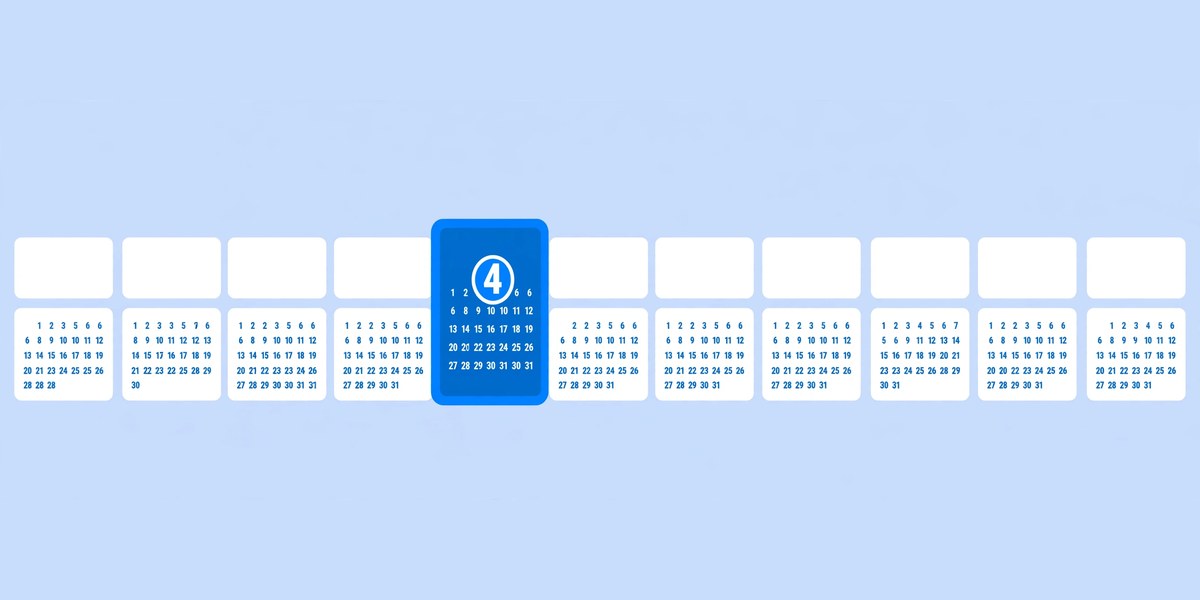
Why Do People Think a Month Is 4 Weeks?
Three habits keep the myth alive:
- Payroll language: Some jobs talk about “four-week pay cycles,” and people mistake a pay cycle for a month. A true monthly salary covers 30 or 31 days, not 28.
- Calendar grids: A month fits on a 4-row calendar grid when it starts mid-week, which makes 4 weeks look like a month’s natural size.
- Quick mental math: Multiplying a weekly amount by 4 is easier than multiplying by 4.33, so people round without noticing the error.
How Many Weeks Are in Each Month of 2026?
Because months start on different weekdays, the number of full weekends inside each month shifts every year. Here is the calendar-week layout for 2026, a standard 365-day year:
- January: 31 days, Thursday to Saturday, touches 5 weekends
- February: 28 days, Sunday to Saturday, touches exactly 4 weekends (the only true 4-week month)
- March: 31 days, Sunday to Tuesday, touches 4 weekends
- April: 30 days, Wednesday to Thursday, touches 4 weekends
- May: 31 days, Friday to Sunday, touches 5 weekends
- June: 30 days, Monday to Tuesday, touches 4 weekends
- July: 31 days, Wednesday to Friday, touches 4 weekends
- August: 31 days, Saturday to Monday, touches 5 weekends
- September: 30 days, Tuesday to Wednesday, touches 4 weekends
- October: 31 days, Thursday to Saturday, touches 5 weekends
- November: 30 days, Sunday to Monday, touches 4 weekends
- December: 31 days, Tuesday to Thursday, touches 4 weekends
Notice how February 2026 is the textbook case: it runs from a Sunday to a Saturday, so it is exactly 4 clean weeks with no partial week at either end. No other month in 2026 manages that.
How Many Weeks Are in an Average Month?
The average month is 365 divided by 12, which is 30.42 days, or 4.35 weeks. The figure most planners use is 52 weeks divided by 12 months, which equals 4.33 weeks per month. Both are close enough for planning, and both are clearly more than 4.
This is the same reason a year is 52 weeks plus 1 day instead of a neat 52 weeks. Those leftover days have to go somewhere, and they land inside the months, stretching 11 of the 12 past the 4-week mark.
When Does the 4-Week Approximation Actually Hurt?
Paychecks and budgets
A worker earning $500 a week makes about $2,167 in an average month ($500 times 4.33), not $2,000. Budgeting with the 4-week figure creates a $167 gap every month, over $2,000 a year.
Rent and billing
Landlords who think in weekly terms sometimes charge 4 weeks of rent per month and then wonder why the annual total falls short. A weekly rent of $400 should produce $20,800 a year, but 12 months at 4 weeks each only collects $19,200. The missing $1,600 is the “extra” days the approximation ignored.
Project deadlines
A “one month” deadline set by multiplying 4 weeks into a schedule loses 2 to 3 days. Over a six-month project, that is roughly two full weeks of vanished time.
How to Convert Between Months and Weeks Correctly
- Weeks to months: Divide by 4.33. A 13-week quarter is about 3 months.
- Months to weeks: Multiply by 4.33. Six months is about 26 weeks.
- For exact dates: Count the days on a calendar and divide by 7, the way you would when you calculate weeks between two dates.
Want a deeper comparison of the two time units? Our guide on how many weeks are in a financial year shows how businesses sidestep this whole problem with calendars built from exact weeks. You can also contact us with a conversion question of your own.
Frequently Asked Questions
Which month is exactly 4 weeks long?
February in a non-leap year, with exactly 28 days. In leap years February has 29 days, so no month is exactly 4 weeks.
Is a month 4 weeks or 30 days?
Months are 28 to 31 days, which is 4 to 4.43 weeks. Neither figure is exact: use the actual day count when precision matters.
How many weeks are in 2 months?
About 8.66 weeks, using the 4.33-week average. The exact figure depends on which two months: January plus February is 8.43 weeks, while July plus August is 8.86 weeks.
Why do calendars show 5 rows for some months?
Because 30- and 31-day months stretch across parts of 5 or 6 calendar weeks depending on which weekday they start on. A month that starts on a Saturday, for example, touches 5 weekly rows.
How many full weekends are in a month?
Usually 4, but a 31-day month that starts on a Friday or Saturday contains 5 weekends. February in a non-leap year starting on a Monday through Friday has exactly 4.
Leave a Reply