
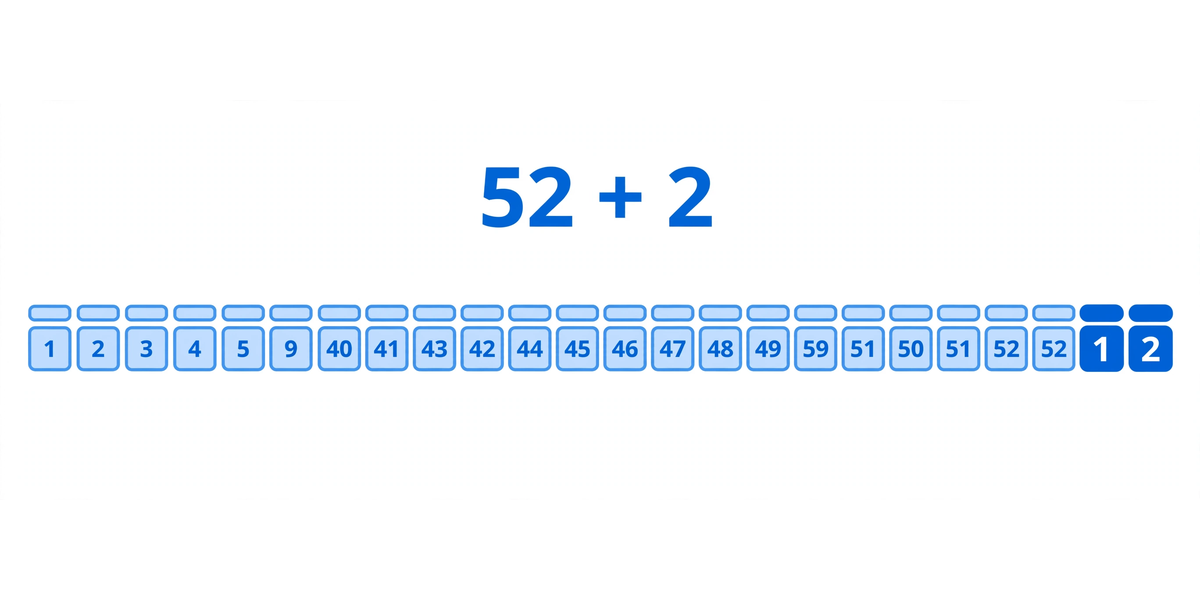
A leap year has 52 full weeks plus 2 extra days, for a total of 366 days. Dividing 366 by 7 gives about 52.29 weeks. A leap year starts from the same 52 weeks and 1 day found in a standard year of 365 days, then adds one extra day, February 29, which creates the second leftover day.
What Is a Leap Year?
A leap year is a calendar year that contains 366 days instead of the usual 365. The extra day is February 29, which appears only in leap years. The Gregorian calendar adds this day about every four years to keep the calendar aligned with Earth’s orbit around the Sun.
Earth takes about 365.2422 days to orbit the Sun. Without leap years, the calendar would drift by roughly one day every four years, and seasons would slowly slide through the months. The leap-day rule keeps the calendar in sync.
The Math: How 366 Days Becomes 52 Weeks and 2 Days
The calculation is simple division:
- 366 days / 7 days per week = 52.2857 weeks, or about 52.29 weeks
- 52 full weeks x 7 days = 364 days
- 366 – 364 = 2 leftover days
So a leap year never contains 53 full calendar weeks. It always contains exactly 52 complete weeks, with 2 days left over. Those leftover days fall on two specific weekdays, which change from one leap year to the next.
Which Weekdays Do the 2 Extra Days Fall On?
The two extra days are always the weekday of January 1 and the weekday of December 31 in that year. The table below shows the upcoming leap years, their starting weekday, and their extra days:
| Leap year | Starts on | Ends on | The 2 extra days |
|---|---|---|---|
| 2028 | Saturday | Sunday | Saturday and Sunday |
| 2032 | Thursday | Friday | Thursday and Friday |
| 2036 | Tuesday | Wednesday | Tuesday and Wednesday |
| 2040 | Sunday | Monday | Sunday and Monday |
| 2044 | Friday | Saturday | Friday and Saturday |
For example, leap year 2028 starts on a Saturday and ends on a Sunday, so its two leftover days are one Saturday and one Sunday. That is why 2028 has 106 weekend days, the most any year can have.
How Leap Years Are Determined
A year is a leap year if it can be divided evenly by 4. There are two exceptions that keep the calendar accurate over centuries:
- If a year is divisible by 100, it is NOT a leap year, unless it is also divisible by 400.
- So 1900 was not a leap year, but 2000 was.
- The next century year, 2100, will not be a leap year.
This rule keeps the average calendar year at 365.2425 days, very close to the true solar year of 365.2422 days.
Leap Years vs. Standard Years: A Quick Comparison
| Year type | Total days | Full weeks | Extra days | Decimal weeks |
|---|---|---|---|---|
| Standard year | 365 | 52 | 1 | 52.14 |
| Leap year | 366 | 52 | 2 | 52.29 |
Both year types contain exactly 52 complete weeks. The difference is only the leftover days: one in a standard year, two in a leap year. To learn how those leftover days create extra weekends, see our guide on how many weekends are in a year.
Worked Example: Counting the Weeks of Leap Year 2028
To see the 52-weeks-plus-2-days structure in action, take 2028 as a worked example. January 1, 2028 is a Saturday. The first partial week runs Saturday, January 1 and Sunday, January 2, which is 2 days. Then 51 full weeks follow, from Monday, January 3 through Sunday, December 25, which is 357 days. Finally, the last partial week runs Monday, December 26 through Sunday, December 31, which is 7 days, but December 31 is the 366th day.
Add it up: 2 + 357 + 7 = 366 days. The two partial weeks at the start and end of the year join together to form the two extra days, one Saturday at the start and one Sunday at the end. Every leap year follows this same pattern, just with different weekdays at the edges.
How February 29 Affects Weekly Routines
The extra day lands in the middle of the year, which shifts the weekday of every date after February 29. If your birthday is on March 10 in a leap year and falls on a Tuesday, it will fall on a Wednesday the following year instead of jumping two weekdays as it would in a standard year.
This shift matters for payroll and scheduling. Employees on weekly pay schedules earn one extra weekly paycheck in leap years only if their pay cycle aligns with the extra days, but most salaried workers simply receive the same annual pay spread across the extra day. Weekly events, classes, and deliveries continue on their normal weekday, they just happen one extra time in February.
What About Years With 53 Weeks?
You may have heard of years with 53 weeks. This comes from the ISO 8601 week-date system, used in business and project planning, not from ordinary calendar weeks. An ISO year has 53 weeks when it starts on a Thursday, or when it is a leap year that starts on a Wednesday.
For example, 2020 was a leap year that started on a Wednesday, and it had 53 ISO weeks. Among the upcoming leap years, 2032 starts on a Thursday and will also have 53 ISO weeks. Even in those years, the calendar still holds only 52 full weeks of 7 days, plus the 2 leftover days.
Why February 29 Exists
The leap day is added to February because February was historically the shortest month of the Roman calendar. When Julius Caesar reformed the calendar in 45 BC, the extra day was placed at the end of February, and the Gregorian calendar kept the tradition.
People born on February 29, called “leaplings,” celebrate birthdays on February 28 or March 1 in non-leap years. There are only about 5 million people worldwide with this birthday.
If you want to know more about how this site explains calendar topics, visit our about us page.
Frequently Asked Questions
How many weeks are in a leap year?
A leap year has 52 full weeks plus 2 extra days, which equals about 52.29 weeks in total.
How many days are in a leap year?
A leap year has 366 days, one more than a standard year, because of the added February 29.
When is the next leap year?
The next leap year is 2028, which starts on a Saturday and ends on a Sunday.
How often do leap years occur?
Leap years occur about every 4 years, except for century years that are not divisible by 400, such as 1900 and 2100.
Can a leap year have 53 weeks?
A leap year always has 52 full calendar weeks plus 2 days. Some leap years, like 2032, have 53 ISO weeks under the ISO 8601 business-week system, but that is a different way of counting.
Why does February get the extra day?
February was the shortest month in the ancient Roman calendar, so the leap day was added there in 45 BC, and the tradition has continued ever since.
Leave a Reply