
A month has about 4.33 weeks on average. The exact number depends on which month you are looking at: a 28-day February has exactly 4 weeks, while 30- and 31-day months have 4 full weeks plus a few extra days. This guide explains the simple math behind weeks in a year and how they break down month by month.
How Many Weeks Are in a Month?
On average, there are about 4.33 weeks in a month. This comes from a simple calculation: a standard year has 52.1775 weeks, and dividing that by 12 months gives roughly 4.345 weeks per month. Most people round this to 4.33 for everyday use.
However, no calendar month contains exactly 4.33 weeks. A month is 28, 29, 30, or 31 days long, so the number of complete 7-day weeks in it is always 4, with 0 to 3 extra days left over.
In short: a month always contains 4 complete weeks, plus 0 extra days in a non-leap February, 1 extra day in a leap-year February, 2 extra days in a 30-day month, and 3 extra days in a 31-day month.
Weeks in Each Month: Full Table
The table below shows the number of days, complete 7-day weeks, and extra days for every month of the year. February has two entries because its length changes in a leap year.
| Month | Days | Complete Weeks | Extra Days |
|---|---|---|---|
| January | 31 | 4 | 3 |
| February (non-leap year) | 28 | 4 | 0 |
| February (leap year) | 29 | 4 | 1 |
| March | 31 | 4 | 3 |
| April | 30 | 4 | 2 |
| May | 31 | 4 | 3 |
| June | 30 | 4 | 2 |
| July | 31 | 4 | 3 |
| August | 31 | 4 | 3 |
| September | 30 | 4 | 2 |
| October | 31 | 4 | 3 |
| November | 30 | 4 | 2 |
| December | 31 | 4 | 3 |
As the table shows, every month contains exactly 4 complete weeks. The only difference is the number of leftover days, which ranges from 0 to 3. This is why a simple answer like “4 weeks” is close but not the full picture.
Why the Answer Isn’t Always 4 Weeks
A month is not a neat multiple of 7 days, and that is the entire reason this question has a longer answer than most people expect. February in a non-leap year is the only month that fits 7-day weeks exactly, with 28 days dividing cleanly into 4 weeks. Every other month has days left over once you count out those four weeks.
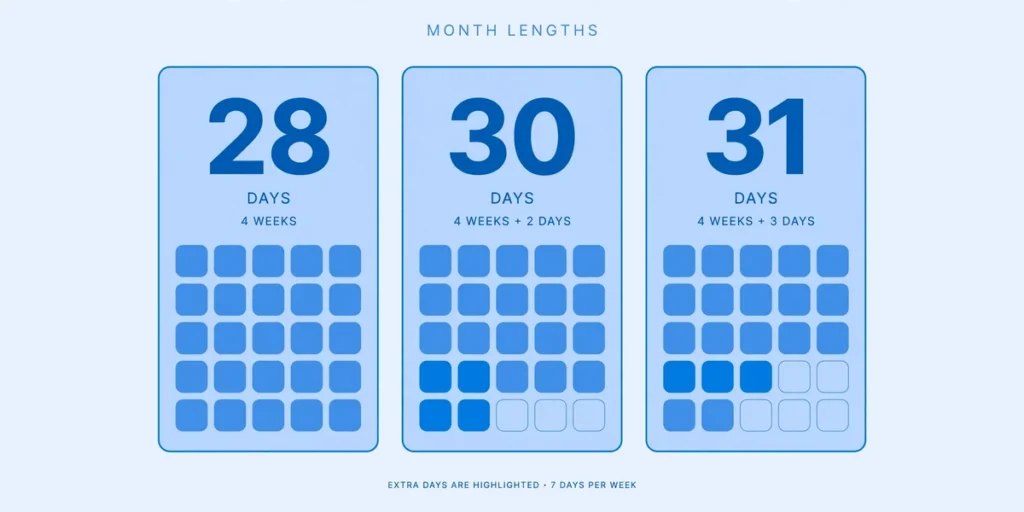
The months of April, June, September, and November have 30 days each, which gives 4 weeks plus 2 extra days. January, March, May, July, August, October, and December have 31 days each, giving 4 weeks plus 3 extra days. February has 28 days in a common year (exactly 4 weeks) and 29 days in a leap year (4 weeks plus 1 day).
Those extra days are also why a standard year has 52 weeks plus 1 extra day, and a leap year has 52 weeks plus 2 extra days. The leftover days from each month accumulate over the course of the year, which is what makes the average month length come out to about 4.33 weeks instead of exactly 4.
Calendar Weeks vs Full 7-Day Weeks
There is a useful distinction between the number of complete 7-day weeks inside a month and the number of calendar week rows a month spans on a printed calendar. On a calendar grid, any 30- or 31-day month always touches 5 or 6 week rows.
This happens because the first and last rows are usually partial weeks. If a 31-day month starts on a Wednesday, for example, the first row shows only 4 days of that month, and the month continues into a sixth row for its final days. The month does not contain 6 full weeks of its own days; it simply spills across 6 rows of the calendar layout.
Whether a month spans 5 or 6 rows depends on two things: how many days it has, and which weekday the 1st falls on. A 28-day February that starts on a Monday fits perfectly into 4 rows. A 30-day month starting on a Saturday or Sunday will typically reach into a sixth row. When people say “this month has 5 weeks,” they are usually describing the calendar grid, not the number of complete 7-day weeks.
How to Calculate Weeks in Any Month
The method is straightforward: divide the number of days in the month by 7. The whole-number part of the answer is the number of complete weeks, and the remainder is the number of extra days.
Here is a worked example using October, which has 31 days:
- Divide 31 by 7: 31 ÷ 7 = 4.4286.
- The whole number, 4, is the number of complete 7-day weeks.
- Multiply 4 × 7 = 28 days accounted for.
- Subtract 31 − 28 = 3 extra days.
So October has 4 weeks and 3 extra days. The same method works for any month and any year. For the average across all months, divide the year’s total weeks by 12: 52.1775 ÷ 12 = 4.345 weeks, commonly rounded to 4.33. Another way to reach the same figure is 365 ÷ 12 ÷ 7 = 4.3452. If you want to see how this connects to the current year, you can read our guide on how many weeks are in 2026.
Weeks in a Month for Planning
Understanding weeks in a month has several practical uses, especially when the difference between 4 and 4.33 matters.
Budgeting and paychecks. If you are paid every two weeks, most months will include two paychecks, but some months will include three. These “3-paycheck months” happen twice a year because months are longer than 4 weeks. Biweekly budgeting that assumes exactly 4 weeks per month will gradually drift off; using 4.33 weeks per month keeps annual totals accurate.
Work schedules and payroll. Monthly payroll periods based on a 4-week cycle will misalign with calendar months over time, creating shortfalls or overlaps. Employers and freelancers who bill by the week benefit from knowing that a 31-day month is 4.43 weeks, not 4, when prorating pay.
School terms and project plans. A four-week study plan leaves up to 3 days unaccounted for in a 31-day month. For deadlines, fitness plans, or savings goals measured in weeks, counting the actual days rather than assuming “4 weeks per month” gives a more reliable schedule. If you have a question we did not cover, you can contact us and we will answer it.
Frequently Asked Questions
Which months have exactly 4 weeks?
Only February in a non-leap year has exactly 4 weeks, because it has exactly 28 days. Every other month has 4 complete weeks plus extra days.
How many weeks are in February?
February has exactly 4 weeks in a common year (28 days) and 4 weeks plus 1 day in a leap year (29 days).
How many weeks are in a 31-day month?
A 31-day month has 4 complete weeks plus 3 extra days. The 31-day months are January, March, May, July, August, October, and December.
How many weeks are in a 30-day month?
A 30-day month has 4 complete weeks plus 2 extra days. The 30-day months are April, June, September, and November.
Why do some calendars show 6 weeks for one month?
A month can span 6 rows on a calendar grid when it starts late in the week and has 30 or 31 days. This counts partial weeks at the start and end of the month, not 6 complete 7-day weeks.
Is the average really 4.33 weeks per month?
Yes. Dividing a standard year’s 52.1775 weeks by 12 months gives about 4.345 weeks, commonly rounded to 4.33. It is an average across all months, not the length of any individual month.
Leave a Reply