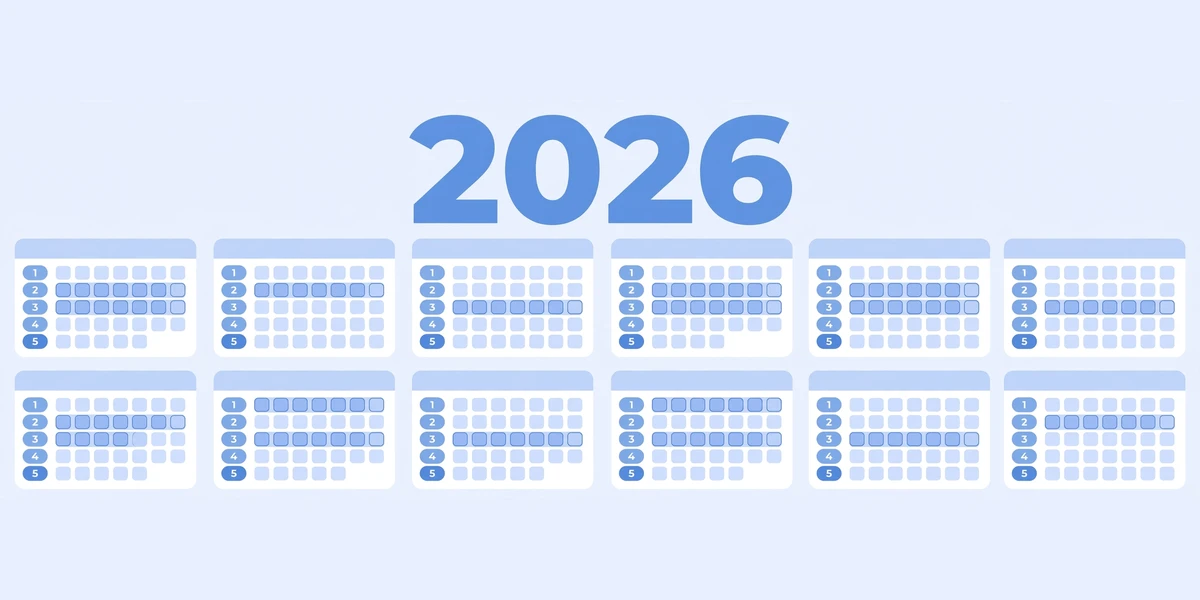
There are 52 full weeks in 2026, plus one extra day, for a total of 365 days. That is the standard answer to how many weeks in a year there are in a common (non-leap) year, and 2026 follows the pattern exactly.
This guide breaks down the 2026 calendar week by week: the simple math, a month-by-month table, weekend counts, ISO week numbering, quarterly totals, and a comparison with the leap years 2024 and 2028.
How Many Weeks Are in 2026?
The quick answer: 2026 contains 52 complete weeks and 1 extra day.
The math is straightforward. A week has exactly 7 days, and 2026 has 365 days. Dividing 365 by 7 gives 52.14, or, worked out precisely:
- 52 × 7 = 364 days
- 365 − 364 = 1 day left over
So 2026 is made up of 52 full weeks plus a single extra day. Because 2026 is not a leap year, there is no February 29 to push the total up to 366 days. A leap year, by comparison, gives 52 full weeks plus 2 extra days.
2026 Month-by-Month Week Breakdown
Calendar months do not divide neatly into weeks: each month contains 4 full weeks plus leftover days (February, with exactly 28 days in 2026, is the one perfect exception). Here is the exact breakdown for every month:
| Month | Days | Full Weeks | Extra Days |
|---|---|---|---|
| January | 31 | 4 | 3 |
| February | 28 | 4 | 0 |
| March | 31 | 4 | 3 |
| April | 30 | 4 | 2 |
| May | 31 | 4 | 3 |
| June | 30 | 4 | 2 |
| July | 31 | 4 | 3 |
| August | 31 | 4 | 3 |
| September | 30 | 4 | 2 |
| October | 31 | 4 | 3 |
| November | 30 | 4 | 2 |
| December | 31 | 4 | 3 |
The twelve months add up to 365 days, or 48 full weeks plus 29 leftover days – which is why the yearly total is the figure that matters. For more on monthly figures, see our guide to how many weeks are in a month.
How Many Weekends Are in 2026?
2026 has 104 weekend days in total: 52 Saturdays and 52 Sundays.
January 1, 2026 falls on a Thursday, and December 31, 2026 also falls on a Thursday. Because the year is 365 days long, every day of the week occurs exactly 52 times – the extra 365th day is itself a Thursday, so no day gets a 53rd occurrence.
Subtracting the 104 weekend days from the 365-day total leaves 261 weekdays. That figure – 261 Monday-to-Friday days – is the one most people actually need when planning work schedules, school terms, or project timelines for the year.
ISO Week Numbers in 2026
Here is where things get interesting: while 2026 plainly contains 52 full weeks plus one extra day, the ISO 8601 week-numbering system labels the year with week numbers 1 through 53. Both statements are correct – they simply measure different things.
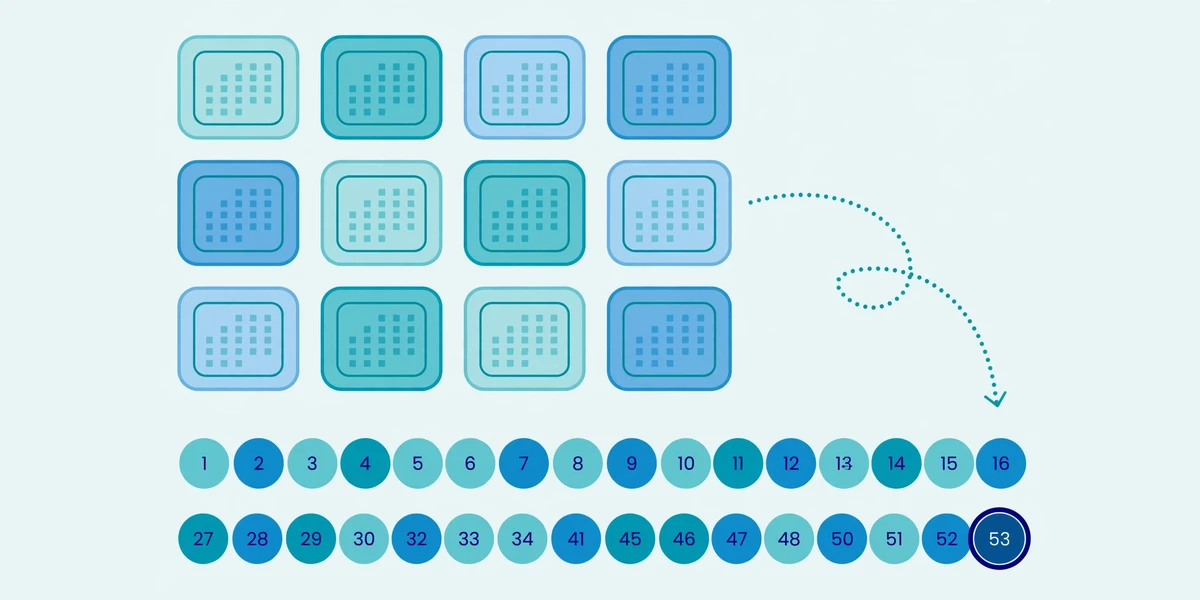
Under ISO 8601, weeks begin on Monday, and week 1 is defined as the week containing the first Thursday of the year. Because January 1, 2026 is itself a Thursday, ISO week 1 of 2026 actually begins on Monday, December 29, 2025 – three days before the year starts.
A year gets a 53rd ISO week when it starts on a Thursday, or is a leap year starting on a Wednesday. Since 2026 starts on a Thursday, its ISO week numbers run 1 to 53, with ISO week 53 running December 28, 2026 to January 3, 2027.
The key point: ISO week numbers are a labeling system for business calendars, not a count of how many 7-day weeks fit inside the year. In plain counting, 2026 still has 52 full weeks and one extra day.
2026 by Quarter
Breaking the year into quarters gives another useful view of the same 365 days, especially for business planning and quarterly goals:
| Quarter | Months | Days | Weeks |
|---|---|---|---|
| Q1 | January – March | 90 | 12 weeks, 6 days |
| Q2 | April – June | 91 | 13 weeks |
| Q3 | July – September | 92 | 13 weeks, 1 day |
| Q4 | October – December | 92 | 13 weeks, 1 day |
Q1 is the shortest at 90 days, Q2 is exactly 13 weeks, and Q3 and Q4 are 13 weeks and 1 day each – together, 365 days, or 52 weeks and 1 day.
2026 vs Leap Years
2026 is a common year of 365 days, but the leap years on either side of it tell a slightly different story:
- 2024 was a leap year with 366 days – 52 full weeks plus 2 extra days. The extra day was February 29.
- 2026 has 365 days – 52 full weeks plus 1 extra day. February has the usual 28 days.
- 2028 will be a leap year with 366 days – 52 full weeks plus 2 extra days.
The difference is small but real: in a leap year, two weekdays occur 53 times instead of one, and there are 262 weekdays rather than 261. Payroll calendars and school terms occasionally shift by a day to absorb the difference.
A year is a leap year if it is divisible by 4 – except for century years, which must also be divisible by 400. That is why 2024 and 2028 qualify as leap years, while the year 2100 will not.
How to Calculate Weeks in Any Year
You can work out the number of weeks in any year with a simple three-step method:
- Find the number of days. Check whether the year is a leap year: 366 days if it is, 365 days if it is not.
- Divide by 7. A common year gives 365 ÷ 7 = 52 with a remainder of 1. A leap year gives 366 ÷ 7 = 52 with a remainder of 2.
- Read the result. Every year contains 52 full weeks. The remainder tells you how many extra days there are: 1 for a common year, 2 for a leap year.
Applied to 2026: not a leap year, so 365 days; 365 ÷ 7 = 52 with 1 day left over – 52 weeks plus 1 day. The method works for any year in the Gregorian calendar.
Frequently Asked Questions
Does 2026 have 53 weeks?
In plain counting, no: 2026 has 52 full weeks plus 1 extra day. Under ISO 8601, however, it is labeled with ISO week numbers 1 through 53, because the year starts on a Thursday – which does not mean it contains 53 full weeks.
How many weekdays are in 2026?
There are 261 weekdays in 2026. With 365 days in total and 104 weekend days (52 Saturdays and 52 Sundays), the remaining 261 days fall on Monday through Friday.
How many pay periods are in 2026?
It depends on the pay schedule. Weekly pay gives 52 pay periods, biweekly pay gives 26, semimonthly pay gives 24, and monthly pay gives 12. With exactly 52 full weeks, 2026 is a standard year for every common pay schedule.
Is 2026 a leap year?
No. 2026 has 365 days, with February running the standard 28 days. The most recent leap year was 2024, and the next one will be 2028.
What day of the week does 2026 start and end on?
January 1, 2026 is a Thursday, and December 31, 2026 is also a Thursday. That single extra day – the 365th day of the year – is what pushes the first day of 2027 to a Friday.
How many days are in 2026?
There are 365 days in 2026. That equals 52 weeks and 1 day, or 8,760 hours in total.
That covers the complete week-by-week picture of 2026. To learn more about our site and how we put together these calendar guides, visit our about page.
Leave a Reply